
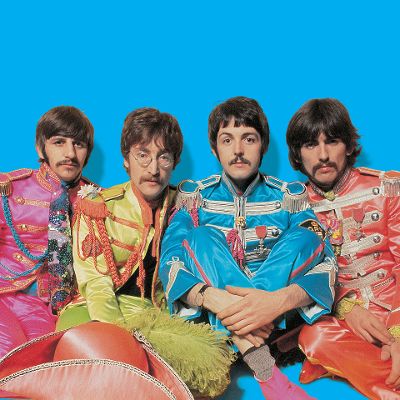
As some may know, this year marks the 50th anniversary of The Beatles’ release of their seminal album Sgt. Pepper’s Lonely Hearts Club Band. To mark the occasion, Apple Corps saw fit to release yet another edition of the record, this time in a new stereo remix by Giles Martin (son of late Beatles producer George Martin), who worked with them to remix the band’s catalog for the Cique de Soleil Love soundtrack. At first, I rolled my eyes. Again? I remember when they made a big to-do over a remaster for the 35th anniversary or something, then it was released again in 2009 with the band’s entire remastered discography. Do we really need to hear it again? Does Sgt. Pepper still have any surprises up his gilded sleeves?
I have a long history with The Beatles, and know their oeuvre intimately. Perhaps surprisingly, I never considered Pepper one of my favorites. Yes of course it is GOOD, even great, but it seemed to pale next to the revolutionary verve of Revolver, the breadth and depth of The White Album, and the widescreen, crystallized perfection of Abbey Road. In retrospect, I think the “media” is to blame (is there a more 2017 statement?). For the past 50 years, Sgt. Pepper has been held up as the “GREATEST ROCK ALBUM OF ALL TIME,” the moment when rock became Art, and the emblem of 1967’s Summer of Love. Some of this may be true, but as someone born in the 1990s, it’s innovations have been to a degree lost on me. The conventions that the Beatles established have been fully integrated into the modern music scene and pop culture at large: it’s hard to see the forest for the trees. I have always appreciated it, but every time I would hear or see it lauded, I would nod my head and agree with it’s greatness, but never felt particularly fulfilled.
And then I listened to this 2017 remix. It is, to use an overused expression, revelatory. Past issues of the album have been merely remasters of the original ’67 studio mixes, to which the band and Martin hardly paid any attention. They concentrated on the mono mix. So, as technology and listening preferences progressed, people have come to know the record through a muddled, unfocused representation of what was actually recorded. “Okay,” I thought, “but can we really hear the difference.?” Yes, yes we can.
Martin went back to the original master recordings and reconstructed each song track by track, based on what was intended to be heard by the artists in mono (and stereo). As a result, each instrument sounds newly alive, kicking out of the speaker and into your ear. New details evident, the sound levels are more equitable, and the entire work just feels more “3D.”
A few things jumped out at me about each track:
- “Sgt. Pepper’s Lonely Hearts Club Band” – Just iconic. Nothing too different here, except that the fanfare that leads into “With a Little Help” is bumped from the end of this one and to the beginning of “Friends.” Doesn’t make a whole lot of difference, unless you are listening on shuffle (??).
- “With a Little Help From My Friends” – I’ve always loved this song. I think it’s my favorite Ringo number. It’s so upbeat and humble, and includes a great performance by Starr (that high note at the end!). Interesting to note, the new edition swaps the songwriting credits for a few of the songs, from Lennon-McCartney to McCartney-Lennon. This presumably is done to demonstrate who had a bigger hand in writing each selection, since it’s now common knowledge that after the mid-60s John and Paul wrote collaboratively only on occasion. Fortunately, this album is one of those occasions.
- “Lucy in the Sky with Diamonds” – Ahhh, “Lucy.” One of the most famous psychedelic songs of all time. This is the first track on the remix that really demonstrates how pumped up the drums sound, with the pre-chorus beat sounding especially deep and strong. Maybe it was just me, but this mixed seemed to emphasize the difference between the drifting, hazy verse and the more upbeat, soaring refrain a little more.
- “Getting Better” – As I mentioned before, the Beatles are best when John and Paul work together, their different personalities and voices playing off each other. “Getting Better” is a perfect reflection of their dynamic: Paul sings the main song, John replies to each line like a sardonic background chorus, cynically commenting on how, even though things are getting better, “they couldn’t get much worse.” I love the subtle production flourishes on this album, like how the music drops out and leaves plink of the piano and conga drums to carry out the song.
- “Fixing a Hole” – Paul’s best lyrics on the album, because they are so ambiguous: what is the hole in his life that he is fixing? Is it actually a leaky hole that needs mending? Does the act of fixing it keep his mind from wandering, or does he fix it so it does not distract his mind from wandering? Either way, it’s rich for personal interpretation, and showcases my favorite guitar solo on the album.
- “She’s Leaving Home” – Never my favorite track, because it’s the most floral and “not rocking,” but the new mix provides an appropriate lushness to the string arrangement. Listening to it this time around, I was struck by how amazing it must have been to throw this on the record player in 1967 and hear a rock band perform with such a baroque accompaniment. That’s the revolution of Sgt. Pepper: even with what was going on the the music business before its release, there had never been a rock band (which at the time was considered little more than a pop fad) produced work of such variety and high quality; it often wasn’t really even “rock n’ roll!”
- “Being For the Benefit of Mr. Kite!” – One of my favorite songs on the album, and it certainly benefits from the remix. The swirling organ, strings, and kaleidoscope of sound is immersive and more defined. Every tinkle, every rush that swings through the soundscape is more visible. This song, more than any perhaps ever recorded, demonstrates the atmosphere of what a circus should conjure. The main melody gets a little buried under the mix towards the end, but it just makes it a little more fun to follow along.
- “Within You Without You” – A masterpiece, and probably my favorite song on the album. George Harrison attempts to replicate an entire Indian raga into a 5 minute song, as well as impart some of the philosophy he gleaned from his study of Hinduism. For the most part, he is very successful. The mix is deep and resonant, and the Martin’s string arrangement seems to dual the tambura. George’s sitar playing is rudimentary, but impressive in his reach and cohesion. The instrumental midsection is quite spellbinding, and the swell at the end is pure epicness.
- “When I’m Sixty-Four” – A goofy song that shows both Paul’s God-tier melodicism and tongue-in-cheek classic pop put-on (something he does often). His lyrics are best when he is knowingly going for the goof, like here. Sometimes (especially in his solo work) his attempts at sincerity come off as corny. Through the pastiche, a more genuine feeling of fun and love comes through.
- “Lovely Rita” – My second favorite song on the disc, the wide open beginning causing elation to anyone withing hearing radius. I have only one criticism. After the final verse, when Paul mentions “sitting on the sofa with a sister or two,” there is an exclamation of “ohh” that leads into the refrain. In the original stereo mix, it was in the background, which made it seem like an emotional escape of a man caught in a moment of song. The new mix brings it up to be as loud as actual lyrics, and increases the harmony. This turns it into a happy and planned harmonized fanfare into the chorus. It removes some of the song’s virility (it’s the seediest song on the album) and makes it seem a little more canned. Please, Giles and Apple, do not make the Beatles sexless. They weren’t.
- “Good Morning Good Morning” – Always a great rocker, the guitar stings and Ringo pounds those drums on the outro. Just because he never took any crazy solos doesn’t mean he is a shoddy drummer. He serves the song, and tears it up.
- “Sgt. Pepper’s Lonely Hearts Club Band (Reprise)” – Let me just say that the guitar sound that George gets in this and “Good Morning,” similar to what Keith Richards does on “Sympathy for the Devil,” is the greatest tone ever found. It’s piercing, fierce, and sounds like what you’d want a great guitar solo to do – cut through it all. Also, the harmonized vocal duet when they sing for the final time “We’re Sgt. Pepper’s one and only Lonely Hearts Club Band” is the stuff that dreams are made of, and they make it sound effortless. A band in it’s prime having fun.
- “A Day in the Life” – What can be said that hasn’t already been said? Considered by many to be the Beatles’ all time best song, it exemplifies everything that this remix does well. It adds fullness to the sounds, deeper and more defined instrumental parts, and puts the harmonies front and center. The orchestral crescendo is great, and I have always loved the magic piano melody of Paul’s bridge. I’ve never noticed this before (and it may not be true) but Paul’s wordless “aaaahhhh” that lift the listener up out of the humdrum of the everyday and “into a dream” seem to slowly warp into John’s voice, as he finishes the vocal heralding and brings us back to the verse. Spellbinding. Last but not least, the final mega piano chord just sounds like a piece of heaven fell and crashed to the ground at your feet – there have been very few perfect ends to totemic albums, and this is one of them. It resonates on and on; you can feel the vibrations. Very cool.
And that’s it. Is it my favorite album now? Not quite. I still prefer the few mentioned at the beginning of this review, but I do appreciate it far, far more than previously. I would love to see the rest of their discography given this treatment, but for now, I’m glad that this canonical album finally got the chance to demonstrate why, exactly, it is in the canon. Because at the end of the day cultural impact can only go so far. It’s the music inside that matters, and the Lonely Hearts Club Band never disappoints.
Addendum: The 2017 release also comes with either 1 or 2 bonus discs (depending on how much you want to shell out) of unreleased studio demos, alternate versions, and rehearsal takes. I haven’t delved into them yet, but I have read good things. I also was pleasantly surprised to hear the more production heavy songs rendered in a more straightforward rock style on Anthology 3, so expect similar revelations from these. The Beatles were a rock band, after all, people!
 Then Play On