
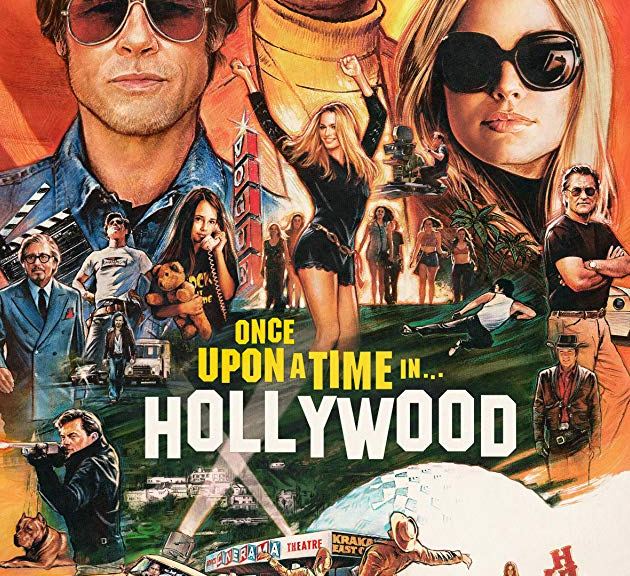
Quentin Tarantino has featured several pairs of “buddies” throughout his films, from Vincent and Jules in Pulp Fiction, to Django and Schultz in Django Unchained. But he’s never made a de facto “buddy comedy,” featuring two friends (typically dudes) who share some adventure and get through it by relying on each other.
That is, he never made one until he released his most recent film, Once Upon a Time in Hollywood. The movie is essentially a Tarantino version of a buddy comedy, centering on actor Rick Dalton (Leonardo DiCaprio) and his stunt double best friend Cliff Booth (Brad Pitt). Compared to the filmmaker’s past several movies, this one is extraordinarily subtle; in a movie where nothing much really happens, the audience is grabbed by these brilliant characters played by two great actors, and the chemistry between them.
At this point in his career, anything Quentin Tarantino puts out is going to be received as some kind of event. He boasts one of the most consistent and provocative filmographies of any modern director, including arguably one of the greatest movies ever in Pulp Fiction. With an outspoken personality to match, Tarantino is the closest thing we have to a rock star filmmaker in 2019. His past several releases have been extremely over the top. Inglorious Basterds and Django Unchained were colorful and violent revenge fantasies, where The Hateful Eight was exceedingly complex and verbose. Once Upon a Time in Hollywood, on the other hand, is pretty low key. It is at once a meditation on age and moving past your prime, as well as a love letter to classic Hollywood.
First off, both DiCaprio and Pitt shine in this movie. DiCaprio truly shows off his range as Dalton, a talented yet washed up alcoholic actor who is facing career irrelevancy. His constant coughing, wheezing, spitting, and sweating is pretty disgusting, yet Leo never makes the character unlikable. On the contrary, I never stopped rooting for him, as we could sense the yearning actor underneath it all.
Pitt, on the other hand, is hilarious. His Cliff Booth is a laid back, weathered man’s man who is perfectly content helping out his friend Rick. Whether he is fixing a TV antenna, fighting Bruce Lee, or facing down a cult of murderous hippies, he is always unflappable and a constant delight to watch.
On that note — yeah, there are murder hippies in this movie. Specifically the Manson Family, an infamous group lead by notorious psychopath Charles Manson that was ultimately responsible for 9 murders. The most famous of these killings were the Tate/LaBianca murders in 1969, the gruesome crime intended by Manson to spark a society cleansing race war. The “Tate” of this case was Sharon Tate (movie star and wife of director Roman Polanski) who in Once Upon a Time in Hollywood is played with bucolic charm by Margot Robbie.
The most charming scene in the film is when Tate goes to the local movie theater to see her latest movie. Robbie plays the moment almost bashfully: here is a young bright eyed woman still reveling in the fact that she is a movie star. In the theater, she quietly goes through the motions of her fight scene, and lights up when the audience laughs at the appropriate time or cheers for her character. It is very endearing and goes a long way towards humanizing Tate for the audience. She was a bright talented actor who simply wanted to entertain. The fact that Tarantino uses actual footage of Tate for the movie on the screen puts it over the top: it’s not only an important grounding moment within the film, but also serves as a beautiful tribute to the real life Sharon Tate. Her sordid end often overshadows her contributions as an actor and celebrity, and this scene in particular stands as a tribute to her and the glamourous innocent world that she represented.
In Tarantino’s world, Dalton lives right next to Polanski and Tate on Cielo Drive in the Hollywood Hills, and it becomes obvious very quickly that the movie is slowly leading up to that fateful night. Tarantino being Tarantino, things don’t go exactly as the history books describe. In a surreal twist of fate, the Family attacks Rick and Cliff in their house, to cathartically bloody results. Cliff, while tripping on acid, absolutely destroys the home invaders with the help of his pit bull Brandy. With tragedy avoided, Rick finally meets Tate and moves into the upper echelon of Hollywood royalty as he always dreamed.
On one hand, the Manson aspect is a small part of the rest of the film, which is most directly a character study of Rick and Cliff. At the same time the family and the murders are the crux around which much of the film is built. QT seems to assume that the audience knows very much about the Manson case, as there are many details and events that are not directly explained but contribute greatly to the overall effect and tone of the film. The scene in which Cliff goes to the Family’s ranch is dripping with foreboding. It’s a very eerie situation that necessarily builds tension for the final act later. But if the viewer isn’t aware that this is the Manson Family, or doesn’t know the details of the case outside of the fact that “Charlie” was a crazy guy who killed people, much of the subtext will be lost.
And what is this subtext? As I stated earlier, Tarantino doesn’t hide the fact that his film is an homage to the movie industry and California generally, as exemplified in the late 1960s. The Manson murders and ensuing media debacle is seen as an end of the perfect California sunshine culture in which everyone left their doors unlocked and didn’t think twice about giving hichhikers a lift. The Family illustrated the potential dark side of the counterculture, and marked the moment when the optimism of the Sixties began to shift into the Seventies’ cynicism and malaise. By preventing the grisly crime from taking place, Rick and Cliff inadvertently preserve the innocence of Los Angeles and the “classic” Hollywood world of movie stars, not to mention the counterculture which was sullied by its association with Manson and his misguided followers. Ultimately, it’s revealed that this film is a revenge fantasy just like Inglorious and Django, except instead of avenging Jews in the Holocaust or American slaves, it’s avenging Tate and the other victims, as well as the entire era in which the movie takes place. In the end, Sharon and the other would-be victims remain alive and happy. Rick and Cliff remain friends, and no one is the wiser for what could have been.
It’s one of the happiest endings that Tarantino has penned, albeit subtly so, just like the rest of his film. All thanks to two washed up buddies.
 Then Play On