
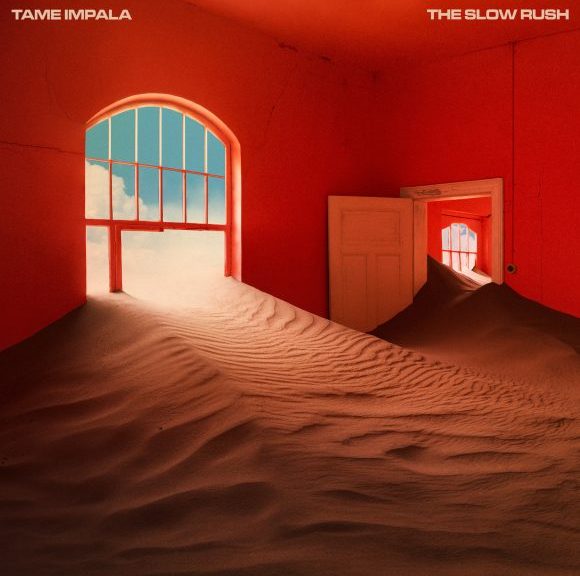
On February 14th, Tame Impala gifted all of us a Valentine by releasing their fourth full length studio album, The Slow Rush. More than just putting out a timely album of personal, introspective lyrics supported by elastic dance-psych, Tame Impala prove that they are perhaps the leading band of our generation. They take the best of what is floating around in modern music and fuse it to their foundation of psychedelic rock to make music that is both deep and accessible. It’s a game changing release.
I’ll be one of the first to admit that I didn’t have very high expectations for Slow Rush. Impala’s last album Currents was a shift away from guitar-centered rock into more electronic frontiers. Yet the music was still driving, and certainly fell under the broader category of what the mainstream would consider “rock” in 2015 (when it was released). At first the change jarred me, although over time I grew to appreciate its hypnotic grooves and slippery vocal lines. Several of my favorite albums are slow growers, so I was amenable to Current’s long neon crawl.
But when I heard single “Patience,” I felt let down. Gone completely is the guitar crunch that so endeared them to me a decade ago, replaced with what I felt at the time to be softpaw R&B, a clear concession to pop sentiment. In the wake of Current’s success bandleader Kevin Parker collaborated with such stars as rappers Kanye West, Lady Gaga, and Mark Ronson. Rihanna even covered the Tame Impala song “New Person, Same Old Mistakes” (retitled “Same Ol’ Mistakes“) on her Anti album, a highlight of which as a whole was considered a landmark artistic success in her career. I figured that he had been influenced by his recent company, which isn’t a bad thing per se, but not what I was exactly looking for from one of the few great rock bands of our time.
Boy was I wrong. The Slow Rush is a magnificent delight of an album, one that can accomodate a dance party, a romantic evening, or a dark night of the soul. Take your pick, this album has a little of everything, often all at once. Yes, it is much more keyboard heavy to the point that it is the dominant, primary melodic instrument. The guitar is used for textural support or rhythmic drive, and is often processed or rode in a funky Nile Rodgers style chop. Nevertheless, the absence is hardly noted because the music made is so good. The Slow Rush creates a warm vibe that cradles tight hooks to pull you on and keep you rolling. Lead single “Borderline” is a fantastically catchy bop that I will love to hear on the radio. Hearing the album in full helps better contextualize and appreciate “Patience” in retrospect. Songs stretch out into trance-like periods of bouncing beats and swirling synth, and the tone perfectly compliments the lyrics.
Frankly, words have never been so important to Tame Impala. Their first album Innerspeaker (2010) is awash in phazed guitar and cyclic drum pounding, notable at first for having a singer that sounds strikingly like John Lennon. But while his voice sounds great, Parker’s lyrics are often obscured by effects and washed out by the crescendos of noodly guitar phlang. 2012’s Lonerism sounds similar but more produced. Added effects and the presence of keyboard expanded the band’s sound, but lyrics, again, are not as critical. While they can be more so understood, they concern themselves with vague philosophizing and general hazy musings. While they compliment the music splendidly and often invoke interesting images, they don’t necessarily confer anything concrete. Currents ponders romantic themes, and it is the first time that anything Parker said connected with me on a personal level.
On Slow Rush, he dives into even more personal concerns, and takes a look around him to consider where he is in life. The sentiments are very relatable to someone my age and add another level of sincere enjoyment to the listening experience. On “Posthumous Forgiveness,” Parker seems to talk to a deceased father or father-figure. “One More Year,” “Lost In Yesterday,” and “One More Hour” provide sensitive ruminations on different stages of a relationship. On the other hand, “Instant Destiny” and “On Track” provide insightful and comforting thoughts about experiencing life as you figure things out.
They are concerns that I think many of my peers share. People in their late-20s to early 30s, the last gasp of the millennial generation. We face the transition from “young adult” to “adult,” with all of the confusion, reckoning, and self-discovery that entails. The songs on The Slow Rush speak to these ideas, in an extremely complimentary musical journey.
There have been many links between electronic music and psychedelic rock in the past, both on the part of experimental keyboard players in prog rock acts as well as the spaced out, sensual dance odysseys of Donna Summer and Giorgio Moroder. Not to mention the hundreds of trance and progressive house DJs who explore similar territories with their work, Parker’s inspiration comes from a wide stretch. Nevertheless The Slow Rush is identifiable as Tame Impala music — made by the same songwriter, with the same sonic and vocal signifiers. This quality is what initially helped me get into Currents, only here it’s done more fully and effectively. I guess that like with all change, it is a process.
In a sense, Tame Impala has always been a band of change. Either their music inspires different head spaces or their lyrics reflect evolving perspectives. In that sense I feel that they are one of, if not THE, most representative bands to show where rock is in this moment. The degree to which they have been embraced by the mainstream only demonstrates their appeal. The best music is always both of its time and timeless, and this fits the bill. In fact, Kevin Parker’s music has been so since he hit his first power chord; it’s one that I’ve come to value and trust.
The album as a piece serves as a lesson in evolution. For music, it impresses that it doesn’t matter what it’s made with to be “good.” Art is about what it says to you, and how it communicates those ideas as feelings. If its popularity introduces people to a broader range of music than mainstream pop and rap, or gets rockists to bask in the allure of sounds other than the guitar, that is a great thing. Tame Impala exhibits how the supposedly “dead” rock genre can evolve to stay relevant, while still remaining true to its ethos. And as for people who listen, The Slow Rush helps explain why change is necessary, difficult, and, ultimately, good.
 Then Play On