
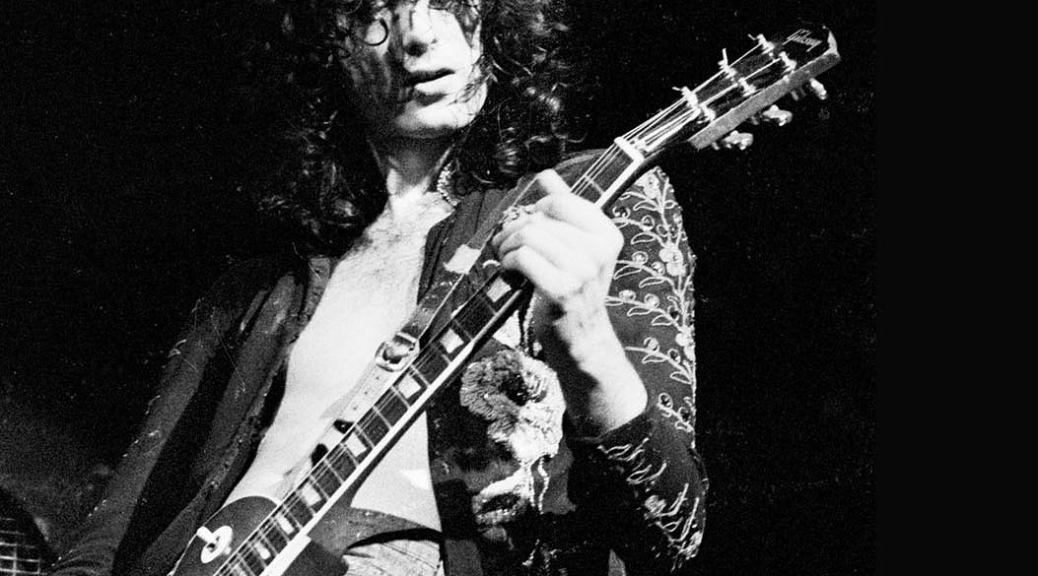
A pale, thin man with long black hair stands astride center stage, shrouded in mist. His garb is bestroon with images of dragons and zodiac signs, and around his neck is slung a guitar. He plays his axe not with a pick, but with a viola bow, which conjures eerie sounds out of the electric instrument, sounds that remind you of a dark night, a full moon, faerie forces on the periphery of human knowledge. As this ritual continues, he builds the sound up to a buzzing crescendo, the bow a wizard’s wand and the guitar a conduit for magic. Once the astral sound hits a peak of climax, the man tosses away the shredded bow and launches into the most face-melting guitar solo you will ever hear.
This bewitching guitar slinger is, of course, Jimmy Page, the leader of hard rock band Led Zeppelin. Ask any rock fan over the past 50 years, and they will agree that Page is one of the greatest guitarists of all time. True, he may not be the most technical player ever (but who really cares about that??), and his live performances, especially later in the band’s career, could be sloppy. But at his peak, no one was meaner. In a word, cool. The sound Page made with Zeppelin as guitarist, lead songwriter, and producer (that last part CANNOT be overstated) virtually created the sound of 70s rock, and, by extension, what we expect hard rock to sound like in general. Beyond that, Jimmy Page is one of the most influential guitarists in rock history not just for his playing and songwriting, but his style. He pretty much made the archetypal image of a “lead guitarist,” the dark yin to singer Robert Plant’s glorious yang. Just look at Aerosmith’s Joe Perry and Guns n’ Roses’ Slash for examples of direct knock-offs.
Okay, we get it. No one really needs to be convinced of Led Zep’s greatness. But what, then, makes Jimmy Page a fascinating person to look at in 2020? Well, here’s a question for you: name something that Page has done since Zeppelin’s disbandment in 1980. I’ll wait.
Yeah. For being one of the most famous and lauded rock musicians in history, Page’s recorded output is extremely weighted toward 1 decade. He is known as the “Led Zeppelin guitarist,” unlike almost every other famous band member who has gone on to be a solo star, take part in other groups, or at least maintain a cult audience for niche releases. Page hasn’t really done any of that.
Let’s take a rundown of his post-Zeppelin output, which consists of a handful of records in 40 years. First is his 1982 soundtrack for the film Death Wish II. As it is, the album is fine; yet it’s a soundtrack so does not stand very well on its own. It’s not something that is going to inspire repeat listens, unless 80s sounding guitar over foreboding atmospherics is your thing. (Even that description is more engaging than the actual music within.)
Next comes the oldies group with Plant and Jeff Beck, labeled The Honeydrippers. They issued one EP in 1984 that actually entered the Billboard charts. It’s a self-conscious homage to ‘50s and early 60’s rock-n-roll, a sort of way for the musicians involved to get back to their roots, and for Page and Plant to perhaps get back into the groove after the death of a bandmate and demise of a band. It’s fun, but slight, and clearly not a signifier of what anyone was going to do next.
For Jimmy, next was a collaboration with folk-rock singer/songwriter Roy Harper in 1985, Whatever Happened to Jugula?. It’s mostly a Harper album with musical input and playing from Page, and while not without merit, it’s definitely a left-of-the-dial release. He then formed the pseudo-supergroup The Firm in the mid-80s (fronted by Paul Rogers). The Firm’s two albums are the definition of mediocre, the kind of records that sound good while you play them but don’t leave a lasting impression. Of note, however, is the song “Midnight Moonlight,” off of their first album. It is reportedly an outtake from Zep’s Physical Graffiti sessions originally titled “Swan Song,” with retooled lyrics. You can totally hear it, and I’d love to hear a version with Plant on vocals.
In 1988 Page released his lone solo album, a middle-of-the-road hard rock effort in which vocal duties are handled by a couple faceless guys named Chris Farlowe and John Miles, and one song features Robert Plant (it’s the best one). The guitar playing is solid but just feels sort of…uninspired, unmemorable, marred by stereotypical 80s production.
By the time the 90s roll around it becomes clear that Page just wants to reunite Led Zeppelin. But there are two problems: firstly, drummer John Bonham is dead and there is no one who can possibly fill his gigantic shoes (and frankly no one ever will); secondly, Robert Plant has no interest in dwelling on past glories, and is firmly committed to moving forward with his solo career. This will become the recurrent theme for the rest of Page’s career, and anything having to do with Zeppelin for the next two decades. So what’s a Pagey to do? Well, find a Plant clone, of course.
The clone in question is David Coverdale, erstwhile Deep Purple vocalist and Whitesnake frontman. Coverdale aspires to be Robert Plant so much it is almost pitiable, from his look to his vocal style. Most famously, Whitesnake’s song “In the Still of the Night” sounds so much like Led Zeppelin that upon release many people thought it was a new track from a reunited Zep, and people still get confused when it comes on the radio. So of course he’d jump at the chance to actually replace his idol in a project with Page. Their resulting album, 1993’s excitingly titled Coverdale/Page, isn’t actually that bad. Page is clearly energized by having a willing collaborator. It must be noted, however, that the project makes no bones about reproducing the Zeppelin sound as Jimmy envisioned it. This quality is the album’s blessing and its curse, as it makes it the most listenable Page solo record and his most frustrating. One can’t help but want to hear what the actual band could have done with this material. Coverdale, for all his chops, is not Robert Plant, and Zeppelin bassist/keyboardist/ringer John Paul Jones would have no doubt added tremendously to the music.
FINALLY, in 1998, Page gets his dream to come true. Low and behold, Plant agrees to collaborate again. Yet it’s different than what many expect. First, they do an episode of MTV Unplugged backed by an Egyptian ensemble. The reinterpretations of the Zeppelin catalogue are well-done and extremely interesting for fans, but truthfully the general public is not going to have much interest. Then they put out a full-blown studio album of all-new material, Walking Into Clarksdale. It’s a subtle album, the definition of a grower. Page & Plant focus on the textured side of their songwriting, largely eschewing the bombastics for which they were so famous in the 70s. Yet the songs are, overall, very good, if not as memorable as the stone-cold classics. It has some good riffs, and the duo incorporate the Middle Eastern sounds pretty well to create lots of groovy, vaguely psychedelic soundscapes. It’s clearly a result of more mature musicians.
At the same time there is one glaring issue about the release. Why in the world did they not invite Jones to participate? Was it so they could have more creative control? Did they not want to further split royalties? Either way, it’s a disheartening slight from collaborators who clearly work better together than separately. Again, his presence would have added to the music unfathomably. Jones reportedly shared the bewilderment, and did not let them forget it when they were inducted into the Rock & Roll Hall of Fame (Quoth he: “I’m glad you remembered to send the me invitation.” Burn!)
And that’s it. Seven studio albums of spotty quality in 18 years, and zero in the past 22 years. What has Jimmy Page been doing all this time? It’s hard to be sure. Of course, Zeppelin fully reunited in 2007 for a one-off performance that is widely hailed as fantastic. It is, but it seemed to exacerbate the problems with Jimmy Page: namely, that he is stuck in the past. He is the curator of Led Zeppelin’s legacy, and seems to spend most of his time endlessly remastering and reissuing, publishing photographic retrospectives or doing interviews about the glory days. Case in point: the guitarist’s one notable release since 1998 is the legendary Lucifer Rising soundtrack, which was written and recorded in the mid-70s. It contains a whopping 30 minutes of extremely avant-garde dark ambience. It’s of interest to fans in regards to Jimmy’s dabblings with magik, and as a historical document for the occult’s relationship with the counterculture. Yet the actual music leaves much to be desired, especially compared to the long simmering hype about the recording. At the end of the day, it was 40 years old when released. Page stated several times that he has new material to put out, but by this point that seems to be pie-in-the-sky navel-gazing. There were rumors after the reunion that Page would be touring with vocalist Myles Kennedy, but that never materialized.
Everything that Page has done since the fall of Zeppelin has been backward-looking. The Honeydrippers looked back to pre-Beatles rock, and literally everything else attempts to recreate Led Zeppelin out of inferior materials. Even his tour with The Black Crowes focused almost entirely on Zeppelin material. It sounds good, and it must have been a great show to go to, but it doesn’t really add anything to the overall tapestry. It’s just another variation on what’s already been done.
His counterpart Robert Plant, on the other hand, has done everything but look back. His solo career in the 80s incorporates pop and electronic sounds, then in the 90s he got into more overt world music. He’s done bluegrass with Alison Krauss, and since 2000 has been producing an exceptionally compelling psych-folk-blues that reveals how deep his artistic vision really is. You get the idea that the only reason he agreed to the 2007 reunion was because it was a one-off – the chance to do it right, to pay homage to their legacy for good, and then move on. Plant’s sense of musical searching has earned my deep respect, and I’m much more satisfied with his post-Zeppelin work than his former partner’s.
So the question remains; why does it seem that Jimmy Page has nothing new to offer? No one can say for sure, but this writer has a theory. Led Zeppelin was so good, and did so much, that the band’s mastermind knows he can never reproduce those heights. Instead of accepting that and doing what he can, he feels that nothing is worth putting out if it isn’t that good. The thing is, it never will be. Plant and Jones understand that; it’s okay for stuff to be different and “not as good,” as your previous best – let alone the best ever! He’ll never find a drummer as good as Bonzo. He’ll never find a singer as simpatico as Plant. To Page, these are insurmountable obstacles. Instead, he’s become obsessed with polishing and showing off his trophies from 50 years ago. I actually feel bad for Page, because despite being on top of the world, he keeps himself in the shadow of his past, and doesn’t seem able to move on and make art for the present.
 Then Play On