
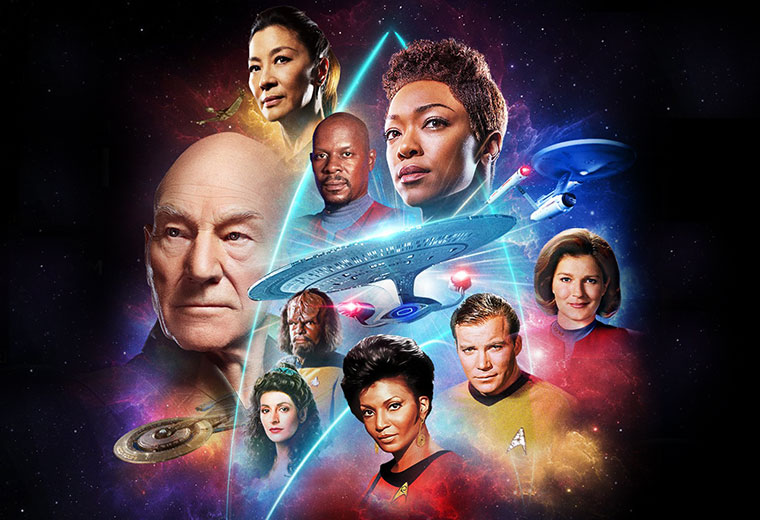
Space – the final frontier. These are the voyages of the starship Enterprise. It’s continuing mission: to explore strange new worlds, to seek out new life and new civilizations, to boldly go where no man has gone before!
There are few phrases in pop culture more iconic than these opening words of Star Trek. Whether spoken by Kirk or Picard, they stand as the defining ethos of the franchise. Given the legacy of Star Trek, they also serve as a sort of definition of science-fiction in general: an optimistic, adventurous drive for knowledge and transcendence. The debut of Star Trek in 1966 in many ways marked the beginning of modern sci-fi as well as the general public’s perception of it. Despite variances in quality or wider reception over the decades, it still stands as a venerable institution.
In my youth I wasn’t very interested in Star Trek. I was a Star Wars fan, and in comparison to that cinematic saga Trek seemed boring. Most of the time they just talked, and there wasn’t even a clear bad guy all the time! About 6 years ago, while searching for a show to stream on Netflix, I decided to give it a try. I like science fiction, and a show with such a massive fan base must be popular for a reason, right? Well, I just recently finished watching through the entire franchise, including the new content being put out by Paramount. I’m very glad I did. I not only now understand the many cultural references it has spawned over the years, but have gained a deeper context through which to think about the speculative fiction that’s come in its wake.
During my junior year of college I took a literature class on science-fiction, and beyond exposing me to some great classics of the genre, it went a long way in shaping my conception of what the whole genre is about. Essentially, SF is a way to reflect and examine our real world. Science-Fiction changes one aspect about our world – a revolutionary technology, an alien race, a novel discovery, an alternate history – and uses it to examine how people would respond to it. This allows for commentary on human nature and society, cultural satire, political criticism, etc.. It takes something “other” and uses it to mirror our own world. Any story that fails to understand the relationship between the real world and its fiction is not true SF.
In this sense, Star Trek is among the truest of science-fiction. Creator Gene Roddenberry very explicitly made the series as a way to comment on contemporary issues and look forward to an optimistic future in which humanity is able to overcome our worldly problems. Conflict does not disappear, but humanity in the world of Trek has the context, means, and ethics to better guide them beyond it. Many of the conflicts in Star Trek are personal, focusing on the contrasts between different cultures or characters’ worldviews. There are territorial and trade disputes, first-contact stories, and, yes, the occasional war.
For those not in the know, here’s the basic premise of Star Trek. In the future (canonically two to three hundred years hence), after surviving near global destruction in two massive wars, Earth has been united. With the invention of matter replication, humanity now exists in a post-scarcity world where all basic needs are met, allowing people to devote their time to other pursuits. Earth’s spacefaring force (ahem) is called Starfleet. After the development of faster-than-light warp capability, Earth joins the United Federation of Planets: a sort of UN-like organization of hundreds of different galactic races united under the precept of peaceful cooperation. As part of the Federation, Earth’s Starfleet serves diplomatic and scientific functions. Not all aliens in the galaxy are friendly, and while Starfleet explicitly is not a military since its primary mandate is exploration, it does serve as defense when necessary. Above all, the Federation is bound by General Order 1, also known as the Prime Directive: no one is allowed to interfere in the natural development of non-warp capable alien civilizations.
The different Trek series follow different starships serving different purposes at different points on the timeline, and all usually build off each other in some way. Admittedly, Star Trek also has a tendency to sometimes be a little cheesy (now they’re in the holodeck portraying Robin Hood’s Merry Men), or self-referential (oh look, Brent Spiner is playing another role), or a little weird (~dream sequences~). Rather than being turn offs, these quirks are what make jumping into a deep well of lore so much fun. In the spirit of this blog, I’m going to rank the main Trek series and go a bit into their pros and cons. Each one brings something new to the ethos of Trek in how it engages with Roddenberry’s original mission statement.
Note: Paramount has already announced two new shows that are going to premier within the year: Strange New Worlds will follow Capt. Pike and his crew of the Enterprise in the years immediately preceding the original series, and Prodigy is a computer animated kids show about a group of youth who steal an abandoned spaceship. It will be fun to watch them as they roll out, and see where they fit into the overall tapestry of the franchise.
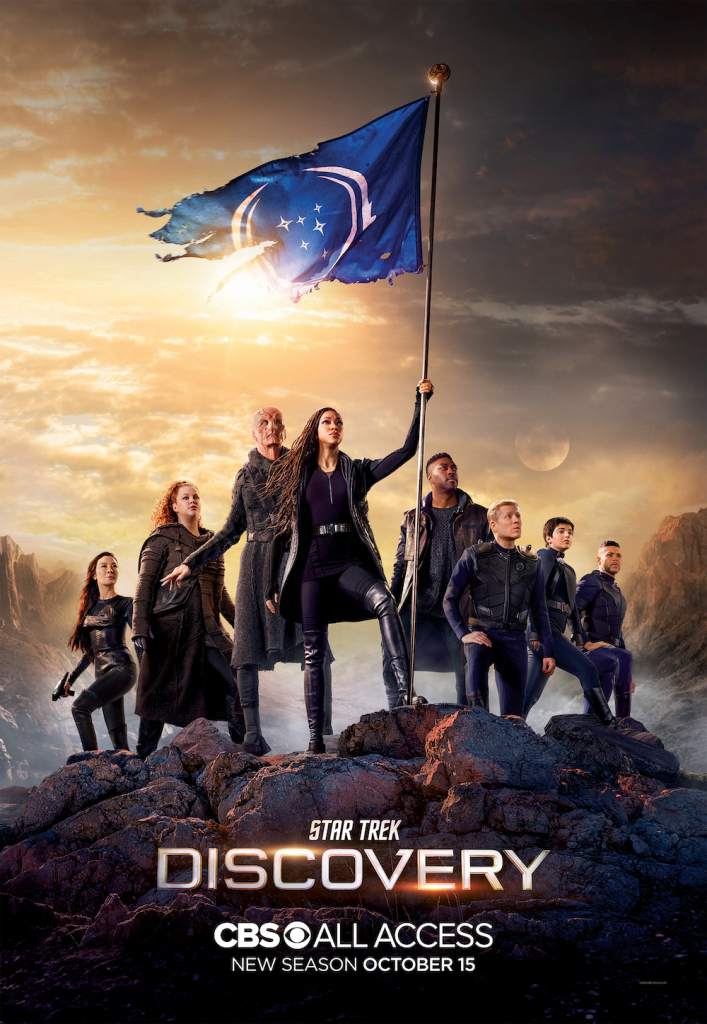
10. Discovery [2017-Present]
While the intent of this list is to hone in on the essence of what Star Trek is all about, unfortunately looking at Discovery is to study what Star Trek is not. When CBS announced that they were bringing Trek back to television for the first time in a decade, expectations were high. Despite the general commercial success of the movies, many fans feel that Trek is best on the small screen where it has room to dig into the universe and characters, instead of trying to be everything to everyone in a feature length film. Showrunners Bryan Singer and Alex Kurtzman talked a big talk about bringing the classic feel of Trek into the modern era, yet Singer (who was actually a writer on Voyager and Enterprise) left after only filming one episode. Now Kurtzman is in complete control, and I’m worried that he misunderstands the spirit of the franchise.
Discovery begins 10 years before the original series, and follows science officer Michael Burnham (despite the name, Burnham is a female who identifies as a woman). In the first episode, she pretty much single-handedly starts a war with the Klingons, and from there the show goes off on a non-stop whirlwind of action. For some reason, the creators seem to think that viewers want to see nothing but massive epic battles, overly dramatic intrigue and double-double-crosses. I call this the Game of Thrones effect, as now every show has to be a convoluted Machiavellian plot. If this was the only issue, it wouldn’t be that big of a deal, but so much is missing from this show. First off, every single thing that happens is a giant UNIVERSE THREATENING event that ONLY BURNHAM is for some reason capable of fixing. They try to cram everything into the show – Section 31! The Mirror Universe! Spock! – and it’s all so contrived. Beyond that, they do a terrible job at character development. Because everything is slave to the overarching EPIC plot, there are no stand-alone episodes that are so vital to getting to know the crew and establishing the universe. I honestly couldn’t even name most bridge crew members, or tell you anything at all about them, as they are all wooden cutouts. The couple times that they do try to delve into a character’s backstory, it’s because that character is going to be killed in the same episode, and they want it to be dramatic. The thing is, character deaths don’t mean anything if we haven’t gotten to care about them beforehand.
Discovery does have a couple bright spots. The special effects are tremendous; the entire show looks great, and it’s heartening to see Star Trek get the beautiful spacescapes it’s always deserved. Despite it feeling like there’s a smaller cast, there are a couple good characters. The Kelpian officer Saru (sensitively portrayed by Doug Jones) is slowly becoming one of my favorite Trek characters. He’s the only crewmember to actually seem like a distinct person, and while I always appreciate a Saru-centric situation, it only highlights how flacid the rest of the cast is. Elsewhere, comedian Tig Notaro’s recurring role as an assistant engineer elevates every scene she’s in. There are a couple good episodes, and Trek shows historically take a season or two to find their feet. The most recent third season, in which they travel permanently into the far future, did mark an improvement. But they still have to do more work moving forward to make Discovery earn its place as the current flagship of the franchise.
It needs extra work because, beyond the lack of character development and contrived plot, the tone is very different from all the other shows. Discovery can almost be described as grimdark Trek, where everything is either shrouded in shadows or obscured by lens flares. The people are caught in a state of emotional strife, the Federation exists in constant turmoil, and pretty much every situation is solved with violence. It’s really disturbing that a supposedly optimistic depiction of our future is apparently worse than our real world; I guess that means that people of our 21st century have truly lost hope.
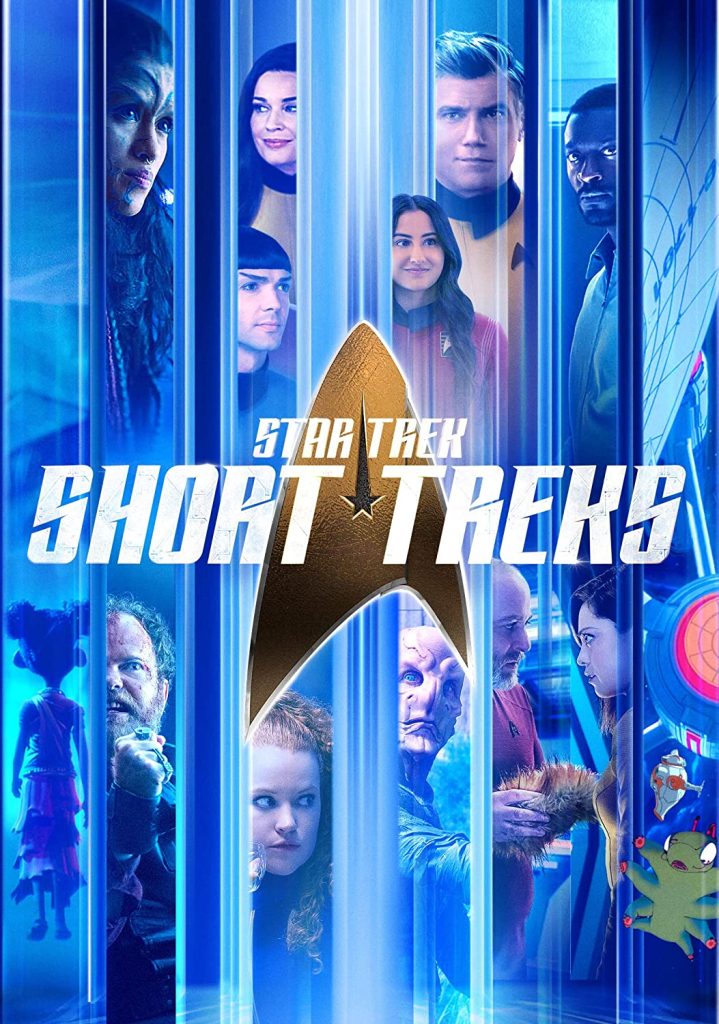
9. Short Treks [2018-2020]
Short Treks isn’t really a full series, but a collection of ten 10-20 minute long stand-alone shorts. Some of them follow Discovery characters as a way to explore their lives (like they should be doing on the actual show), and others look at original people and situations. Most of them are pretty light hearted, but there’s a couple that are heavier. Some of my favorites are the one that shows how Saru joined Starfleet, and another that shows the starship Discovery found adrift and abandoned in the far future as the person who finds it lives there for a while with the company of the ship AI. There’s also a couple animated episodes, and one in particular takes place during the TOS era and includes a quick cameo from Kirk and McCoy. It doesn’t seem like any more will be made, so while Short Treks really are a footnote to the franchise as a whole, they provided a needed diversion as I watched through Discovery.
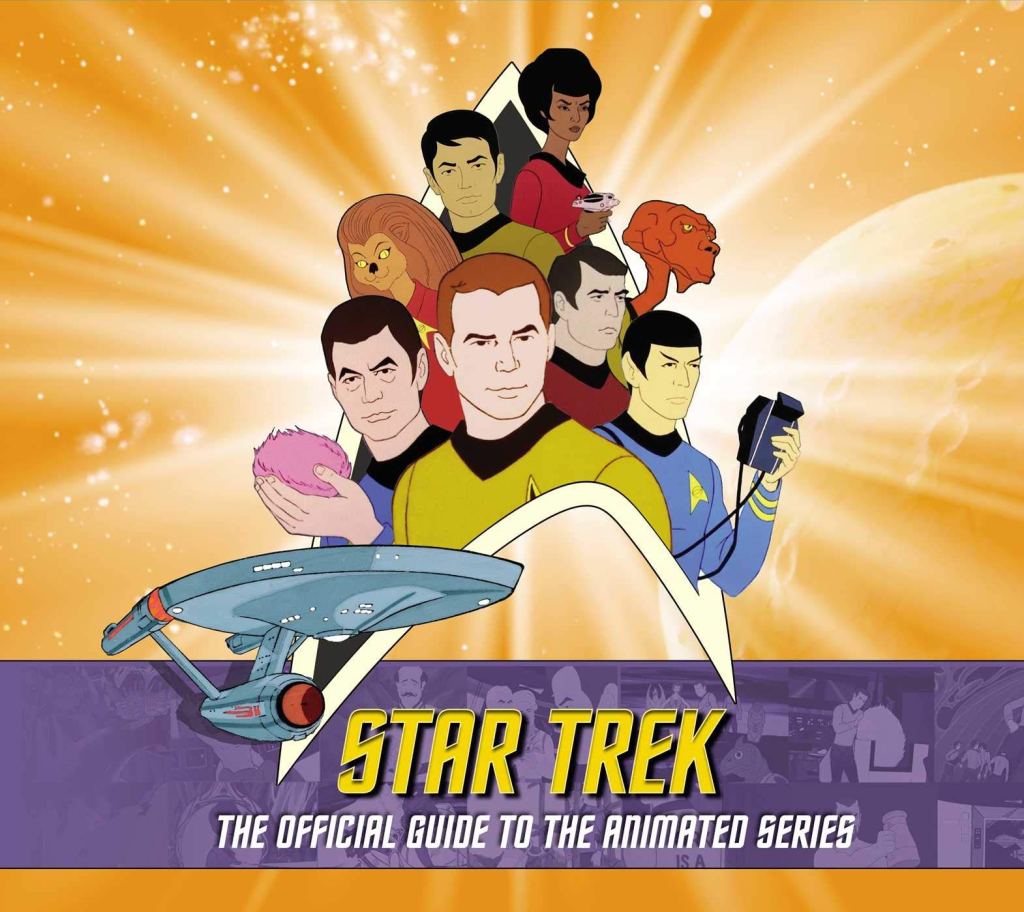
8. The Animated Series [1973-1974]
The original Star Trek series was too far ahead of its time. While it had a strong cult-audience that would only grow, it was cancelled after 3 seasons. The abrupt end left Roddenberry and fans hanging with 2 years left of the Enterprise’s 5-year mission to detail. A few years after the cancellation, they launched Star Trek: The Animated Series, which ran for 2 seasons and actually brought back the original show’s writers as well as the entire cast. In this sense it really is a continuation of the original show. There are major pros and cons to TAS though. First off, the episodes are only 30 minutes as opposed to the hour long norm. This is a shame, as some of TAS’s stories are great, and would have benefitted big time if developed into a longer run time. The animation is also very dated and not very fluid. At the same time the nature of animation allows them to explore concepts that were not possible on the original’s meagre special effects budget. This includes showcasing more interesting aliens and visually rich planets. The Season 1 episode “Yesteryear” is straight up one of the best Star Trek episodes ever – an extremely affecting look back at Spock’s childhood and foundational character. The Animated Series comes highly recommended to fans, though its short existence and the drawbacks noted above mark it as among the least of the franchise.
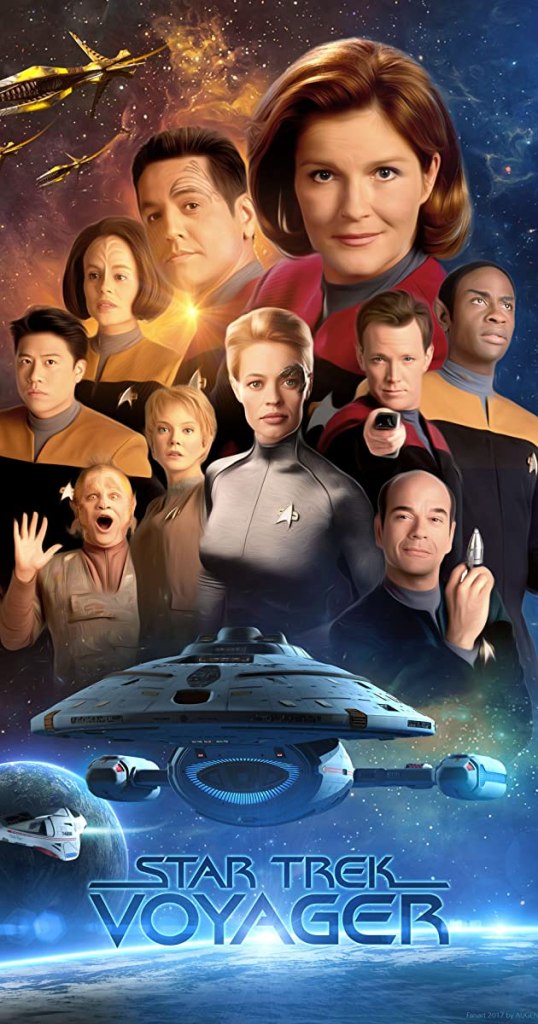
7. Voyager [1995-2001]
Oh, Voyager….what could have been. Of all of the classic Trek shows, this is by far the worst. It has an amazing premise that is completely wasted through inconsistent writing and creative floundering. Notable for having the first female series lead in Captain Katherine Janeway (portrayed with steely confidence by the fantastic Kate Mulgrew), Star Trek: Voyager follows the eponymous ship as it pursues a Maquis terrorist cruiser into an area of space known as the Badlands. In a freak accident, however, both ships get thrown into the Delta Quadrant – the farthest unexplored part of the galaxy. It is estimated that it will take at least 75 years at full warp to return home. Faced with limited resources, both Starfleet and Maquis are forced to join forces for the journey home.
It sounds amazing, but the writers only occasionally develop the idea. Most episodes are self-contained, and no matter what hardships the crew endures from week to week, they always seem to be perfectly fine by the start of the next episode. On top of this, the Maquis integrate surprisingly easily into Voyager’s crew, with superficial conflict only sometimes popping up between them. It could have been a fascinating look at a stranded Starfleet crew, but it comes off more like a soap-opera Next Generation. Apparently this was intentional by the showrunners, as they wanted to return to a more comfortable tone after the boundary-pushing Deep Space Nine. If you do have the hankerin’ for classic gooiness, Voyager will scratch your itch. It’s just a shame that such an original premise is abandoned for something that could have been good in a different context. Another drawback for Voyager are its weaker characters. You have the wooden Kes, smarmy Tom Paris, naive Harry Kim, and Chakotay, whose only defining character trait is that he’s Native American. The show also includes Neelix, who is widely accepted to be hands-down the most annoying Star Trek character ever (although Ethan Phillips has fun with the role). There’s also the idiotic Kazon, not-Klingons who for some reason the writers kept around as the primary antagonists for far too long.
THAT SAID, there are good episodes over its 7 season run. Being in the Delta Quadrant gives us a glimpse at aliens not seen in any other series. The Vidiians were a pretty intriguing and genuinely scary alien race that I wish we had seen more of. The Hirogens (hunters, essentially Trek’s version of the Predator), and the mysterious Species 8472 all presented unique problems for the crew to solve. Of course, once Voyager runs into Borg space during the back half of the show things get much more interesting. We get our first Borg crewmate, Jeri Ryan’s nuanced Seven of Nine. There’s also the always hilarious Emergency Medical Hologram, who played by Robert Picardo steals pretty much every scene he’s in. Notably, Tim Russ as Tuvok takes on the challenge of portraying the first Vulcan main character since Spock, and they do a good job of establishing him as his own unique character while still incorporating broader elements of what makes one a Vulcan. At the end of the day if you like Trek, you’ll like Voyager, but given the squandered premise and the successes of the other Trek iterations, I have to put it at number 7.
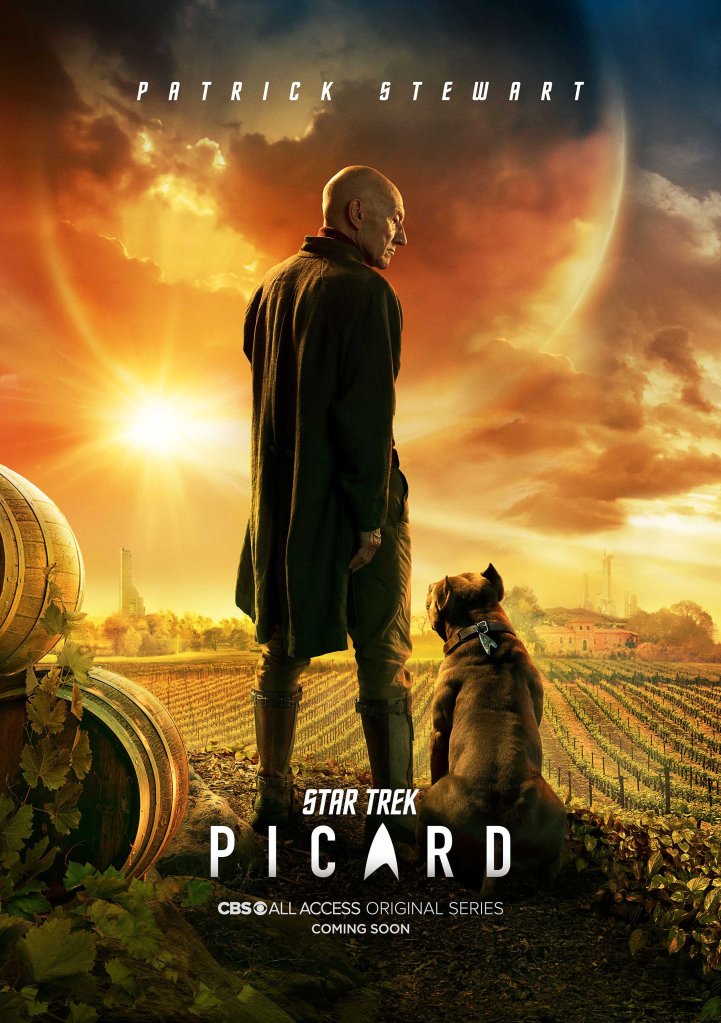
6. Picard [2020-Present]
Captain Jean-Luc Picard is by far one of the most beloved Star Trek characters. In fact, next to Spock, he may very well be the fan favorite. So when CBS decided to reboot the television franchise with a slate of new programming, it was kind of a no-brainer to revisit the ol’ Frenchman man see what he’s up to. Of course, actor Patrick Steward is quite old now, and it was obvious going in that the show was going to in some way address both the character and actor’s legacy, impending mortality, and past regrets. (In fact, Stewart did the same for his Professor Xavier in the dark and critically lauded X-Men film Logan.) It’s hard to judge an ongoing show based on just one season, but so far the results are hit and miss. Like Discovery, there are some aspects that I still can’t reckon with what we otherwise know about Star Trek, but at the same time Picard does a much better job of building its world and fostering its characters than its sister show.
The season opens 30 years after the end of Next Generation, and 14 years after Picard retired from Starfleet. He now lives on his family’s ancestral winery, with two Romulan housekeepers. Wait, Romulans?? Yes, you read that correctly. One of the best parts of Picard is that it’s the first Trek property to truly advance the universe’s timeline past Voyager and Nemesis, the last movie. Well, it gets a little complicated. Ready to geek out for a sec? Okay, here we go: in the 2009 reboot movie, it’s revealed that the planet Romulus is destroyed by their sun going supernova. In that film, a vengeful Romulan crew travels to a parallel dimension to exact revenge and save a version of their planet; it is in this alternate timeline that that trilogy takes place. But back in the Prime Timeline, the former Romulan Star Empire is now a scattered, refugee society. We learn that the Federation essentially turned its back on them. (Like, oh, one of our longest running enemies is getting destroyed? Hmm….okay). Yet Picard felt like that refusal to help betrayed the Federation’s core principles, so resigned his commission. In other news, there was an unexplained android attack on Mars, so now all synthetic life is banned in Federation space. Considering Picard’s past relationship with the android Data, this discriminatory regulation does not sit well with him. In the first episode, our hero gets contacted by a young woman who is not what she initially seems, and regret over his lingering obligations spurs him to jump back into space for one last personal mission.
First, the pros. The acting is very strong. The writers use this to their advantage, and are able to develop the characters through interaction and dialogue while still focusing on the primary narrative. The narrative, overall, is pretty intriguing. Over the course of the 10 episodes we greatly expand upon Romulan culture, corruption within the Federation, reintroductoin of former Borg drones into society, and the conflict between biological and synthetic life. I’m interested where they take things moving forward. There’s also a few cameos from well loved past characters that are by and large used very well. Seven of Nine notably shows back up as a full main character. Finally, without giving too much away, the season ultimately becomes a welcome homage to Data, who was given a less-than-fulfilling send off in Nemesis.
Now, cons. New Trek seems so intent on deconstructing the the Federation that it often feels difficult to see them as a entity of good at all, and that can make for a wonky feeling. Furthermore, just because you can use curse words, doesn’t mean you should. I have zero problem with adult language, but it often feels like both Picard and Discovery add in language just to make things seem “cool” and “modern.” It’s these seemingly small wrinkles that make it seem divorced from the rest of the Star Trek universe. All in all, it’s a non-traditional Trek, but the resulting combination of nostalgia with considered narrative makes for a show with potential.
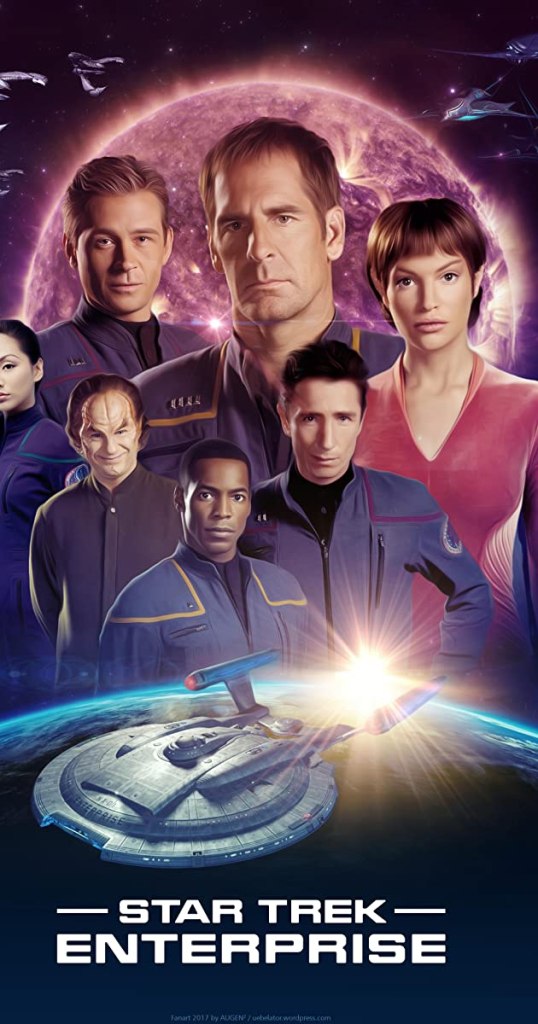
5. Enterprise [2001-2005]
Poor Enterprise often gets the short shrift when it comes to Trek series. It was only around for 4 seasons when it was cancelled, and marked the end of Star Trek until its 2009 reboot. While it’s justifiably not held in as high of esteem as the best of Trek, I feel that it’s underrated at large and could have gotten even better if given the chance. The potential red flag for Star Trek: Enterprise is that it’s a prequel set 100 years before the original series and follows Earth’s first Warp-5 capable starship. (In the normal Star Trek era, ships can reach up to Warp-10). In a pre-Federation galaxy, we witness Starfleet’s first encounters with many of the aliens that would be mainstays in the rest of the series. Enterprise also boasts a sliiiigghhty more realistic portrayal of space travel and exploration, before Starfleet had “better technology.” I’m usually not a fan of prequels, as writers often force the story to be slave to what’s already supposed to come instead of opening up new paths, and there’s a tendency to shoehorn in fan favorite characters and places. Enterprise’s bigger problem is the opposite: it makes too many additions that don’t make sense in light of earlier series that supposedly occur later in the timeline. It’s stereotypical to joke about Trekkies’ obsession with canon, but this is one case in which I agree. Canon can be retconned and handwaved, but in the end it would make a more satisfying show to work within the parameters you’ve already set. (That whack Temporal Cold War arc – come on, man!) At the same time, by 2001 Trek had been on the air for a long time, and the writers didn’t do enough to differentiate individual episodes from storylines that had come before. Many episodes are simply rehashes of what had been done more successfully in prior iterations. There’s also a 2000s era, post-9/11 edginess to the style, like they are consciously trying to make it seem “cool” and “sexy” to a newer, more cynical audience. The results are hit or miss.
HOWEVER, the show takes a major leap in Season 3 with the introduction of the Xindi, and from there tells a season-long arc that successfully builds momentum until the end. The fourth and final season is made up of individual two to three episode arcs that tie into existing Trek lore in fun, interesting ways. By the end of the final two seasons you care about the crewmates much more, and it’s a shame that they weren’t given more time. Through it all, Scott Bakula plays a driven and admirable Capt. Jonathan Archer. His main back-and-forths are between down-to-Earth Trip Tucker (played with an aw-shucks sentiment by Connor Trinneer) and the capable yet troubled T’Pol (Jolene Blalock, who elevates the role from what’s clearly designed to be eye candy to a great Vulcan in her own right). It brings to mind the Kirk/Spock/McCoy triangle from the original series. Enterprise also hosts the franchise’s best medical officer in Phlox, the Denobulan doctor who provides a jovial warmth and quirkily pushes his human crewmates out of their comfort zones. Unfortunately, it also has one of the few Trek main characters that I actively dislike: the dickish head of security Malcolm Reed. (No offense to the actor who played him!) For a while, it seemed like Enterprise would be the last flight for Star Trek on the small screen, and while I’m glad it’s not. Yet it’s far from the whimper many fans make it out to be.
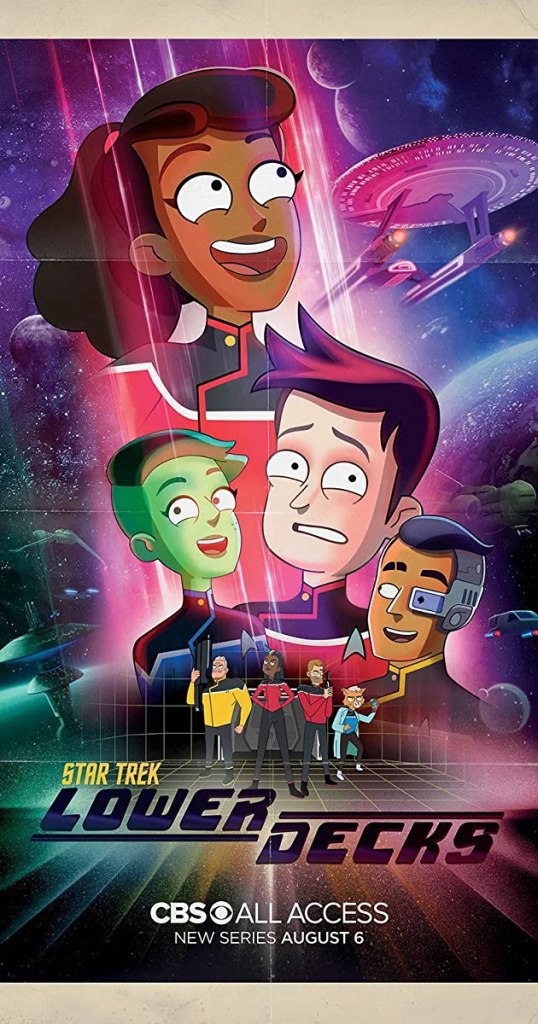
4. Lower Decks [2020-Present]
What a surprise Lower Decks turned out to be. Based on an identically titled Next Generation episode which follows low ranking Enterprise crew members instead of the commanding officers, this animated show is an adult comedy. In the vein of The Simpsons or Family Guy, it contains raunchy humor and witty, fast paced dialogue. The art is extremely reminiscent of Rick & Morty, which makes sense in a similar sci-fi setting, but I was worried at first that Lower Decks would try too hard and end up being eye-rolling.
I was pleasantly mistaken. In just its first season, LD does a fantastic job of telling funny yet worthwhile stories that lovingly parody tropes of the franchise. It canonically takes place sometime after the Nemesis movie, and follows a second-tier Starfleet ship called the Cerritos. The four main characters are two human ensigns (one who is a yes-man, the other demonstrates a cavalier disregard for rules), a good-natured cyborg engineer, and a sweetly naive Orion medical assistant. We also get to know the actual commanding officers pretty well, and by the end of the season the Cerritos’ crew feels much more like the tight unit you’d expect in Star Trek than anything that we get in Discovery or Picard. Similarly to the original Animated Series, the medium allows them to be more conceptually and visually creative than what you’d see in a live action show, and despite the humor each episode is actually a pretty good inventive Trek story. Speaking of the humor, the show is genuinely funny. It’s not as consistently uproarious as Rick & Morty, but each episode gives me a couple good chuckles, and on rare occasions a real lol.
I honestly don’t have any negatives to mention, other than the caveat that in order to fully enjoy Lower Decks, you have to already be a fan of Star Trek. A new fan won’t catch or appreciate every reference, but will probably still enjoy an episode in and of itself. More than just jokes and cool visuals, Lower Decks actually understands the goodness at the heart of Trek. No matter how madcap things may get, the crew sticks to their higher Federation ideals, and there’s always a positive moral or growth in each situation’s resolution. The final episode, in particular, is amazing. It tells a cool story that thoughtfully grapples with valid critiques of the Federation. The self-awareness it exhibits allows the show to engage both fans and the canon with respect, and I’m excited to see where they take the second season.
Lower Decks doesn’t break any animation boundaries, but in another sense it’s by far the best of the new shows: it manages to be a love letter to all things Trek while taking the franchise somewhere novel and fresh.
3. The Original Series [1966-1969]
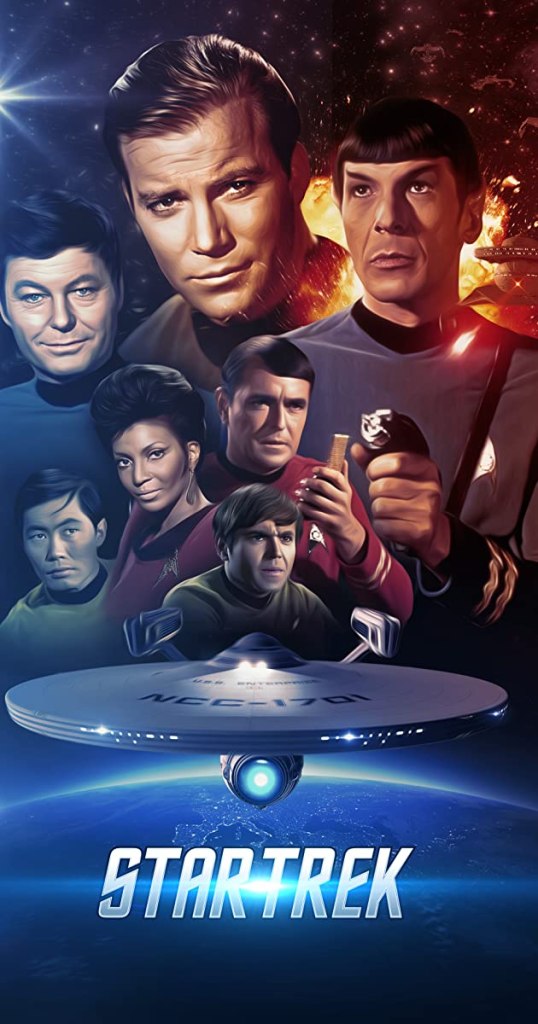
The one that started it all. The original Star Trek series is still a cultural touchstone, and established the basic elements of everything that would come after. In that sense it is essential. It represents Gene Roddenberry’s vision of a positive future in which mankind works past its planet-bound divisiveness. They fly amongst the stars in the pursuit of knowledge, not afraid to have a little adventure here and there. But first, let’s get something out of the way: the special effects are terrible. Even for a show of its time it seems cheap. If you can accept that and look beyond it, it still holds up as a great old school Buck Rogers-like whiz-bang sci-fi show. You have Captain Kirk leading the intrepid crew of the Enterprise on a five year mission of exploration, and through them we encounter all the dangers the universe has to offer. Of course, much of the show’s draw comes from the triumvirate between William Shatner’s swaggering Kirk, DeForest Kelley’s sceptical yet warm-hearted Dr. Leonard “Bones” McCoy, and Leonard Nimoy’s astute Spock. It’s no surprise that Spock is the breakout character and unofficial mascot for the entire Trek franchise. As science-officer and XO, Spock acts as tempering-gent and indispensable advisor to the sometimes hot-headed Kirk, and his navigation of Vulcan logic with human emotion is one of the central themes of the show. Let’s face it: Spock is just plain cool, and in Nimoy we had an actor who perfectly embodied the role.
The Original Series is known to be quite progressive for its time in its treatment of women and non-white members of its cast, as well as how it directly addressed then-current social issues. That seems to be true, but TOS is also very of its time. The series does suffer a bit in retrospect due to changing social norms in this regard. It’s nothing horrendous, but I have a hard time believing that some representations would fly on TV nowadays. In a way, it all does kind of compliment the good-natured campiness of the show but it could be corny to some. Elsewhere TOS displays a relative basicness and lack of overarching storyline, but these are minor quibbles. The Original Series is chock full of inventive and engaging episodes. We have first contact with the calculating Romulans, which turns into a suspenseful game of cat-and-mouse. There’s the ongoing cold war with the imperialist Klingons. There’s the showdown with the planet destroyer. We get our first glimpse of Planet Vulcan at Spock’s pon far. We get the Mirror Universe. Kirk’s fight with the Gorn. Sulu fencing. Omnipotent beings. Tribbles!! Fundamental to understanding what Star Trek is all about.
2. Deep Space Nine [1993-1999]
War isn’t something that Star Trek focuses on much. In fact, most of the series very pointedly attempts to avoid it. Yet even in the most utopian societies, sometimes conflict is inevitable, and Star Trek: Deep Space Nine is about what happens when things get ugly.
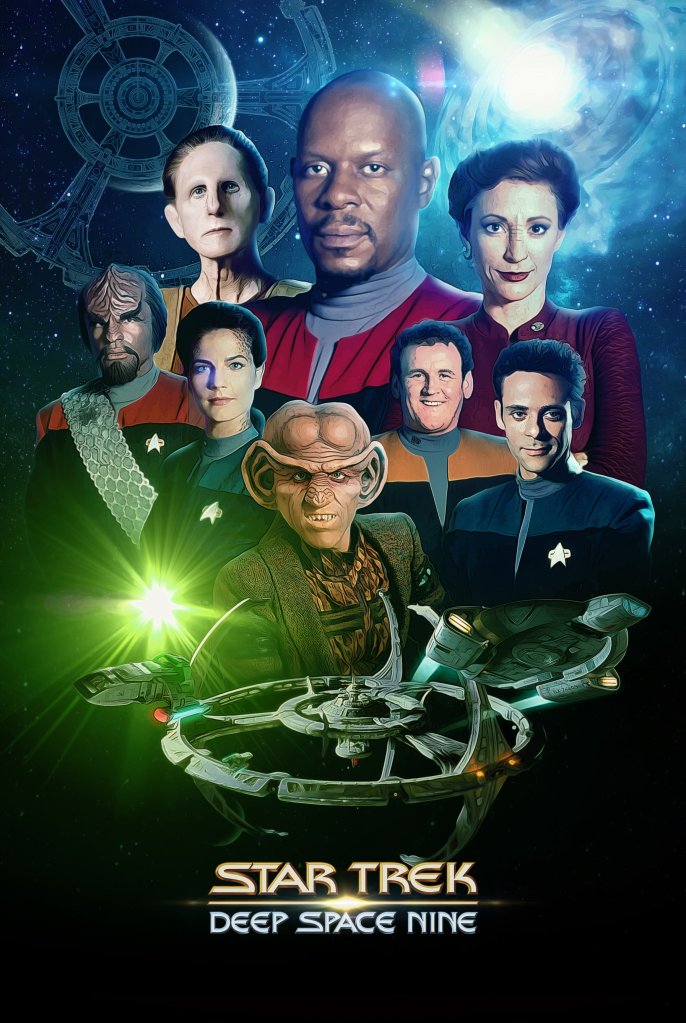
From the start, DS9 was an outlier in the franchise: as most Trek series are about a crew on a starship going to new locations every week, this one is stationary. The show follows Captain Benjamin Sisko (portrayed by Avery Brooks – the first black Trek lead) who gets posted to command the namesake space station: the farthest outpost in Federation space. The station orbits the planet Bajor, which is newly liberated from oppressive Cardassian occupation. Sisko’s mission is to help Bajor’s reconstruction and shepherd them into Federation membership. However, it all hits the fan when they discover a nearby stable wormhole that leads to the unexplored Gamma Quadrant. To the deeply religious Bajorans the wormhole is a prophetic sign, but on a broader scale it marks the station as a flashpoint of galactic activity. After a while the Federation comes into conflict with the Dominion, a sort of nega-Federation political power from the Gamma Quadrant. Before long our heroes find themselves in the midst of a full scale war, and the show takes off. It was the first Star Trek show to go completely serialized; that is, it tells one long story with each episode acting as a chapter, rather than each episode stand as a self-contained story like much traditional television. You can draw a direct line from DS9 to the byzantine political intrigue that made Game of Thrones so popular. As the war goes on, the show explores darker ideas such as PTSD, the relationship between church and state, the fine line between freedom fighter and terrorist, and how far you can stretch your ethics so that the end still justifies the means.
Along with a more complex narrative, the show still boasts the strong characterization that so typifies Trek. Besides the passionate yet conflicted Sisko, we have the intelligent yet inexperienced Julien Bashir, the dedicated but rash Kira Neyris, the stern yet kindly Odo, the youthful yet wise Jadzia Dax, and the grumbling everyman Miles O’Brien. There’s also everyone’s favorite Klingon Mr. Worf, fresh off of exploring the galaxy on the Enterprise and ready to take on new challenges at his wartime post. Last but not least, there’s Quark, the Ferengi bartender who holds court off of the station’s Promenade. Since Spock, Trek usually uses the main alien cast members as a way to comment on humanity and engage in ideas that humans normally wouldn’t discuss openly between themselves. Quark may be the most effective such character: he lives by the ideals of greed, personal benefit, and deceit, completely opposite to that which the Federation espouses. Yet over the course of the series he is forced to work with them for his survival, and the give and take between him and different characters is consistently entertaining. Actor Armin Simmerman does a hell of a job in the role. I could write on and on about the different aspects of what makes this show great, from the character relationships to the acting to the rip-roaring narrative. It features the single best villain in Star Trek, the Cardassian despot Gul Dukat. It even has an episode about the crew playing Vulcans in a baseball game! To be honest DS9 may actually be my personal favorite Star Trek. Yet, for the purpose of ranking the Best Star Trek, I have to look at which show sits at the perfect intersection between being good while also most completely showcasing the classic elements of what Star Trek is all about. In that regard, it’s obvious which takes the cake.

- The Next Generation [1987-1994]
On my mark, Number One.
…Engage!
Trek creator Gene Roddenberry died after the second season of Star Trek: The Next Generation. Control was then passed on to protege Rick Berman and head writer Michael Piller, who would do the true leg work of ushering Trek into the modern era. In this sense The Next Generation is the best representation of both Roddenberry’s original vision mixed with the more developed potential of said vision. Taking place 100 years after the Original Series, TNG follows the new Starfleet flagship, also named Enterprise.
Enterprise is captained by Jean-Luc Picard, who is played with commanding authority by Patrick Stewart. Stewart’s Shakespearean gravitas imbues Picard with a grace not found in any other captain. In many ways he is the full embodiment of Trek values: interests include literature, history, anthropology, art, music, and diplomacy. These qualities seem the complete opposite of what you want as a lead character in a mainstream adventure series, but Picard uses his knowledge and temperament to capably lead the Enterprise crew as an unflagging pillar of good. The Next Generation made Stewart a star outside of the realm of British theater, and Capt. Picard is still his defining role. So what about the rest of the crew? Iconic, across the board. Jonathan Frakes’ Commander Will Riker does a good job of holding it down as XO while also being a swaggering flirt. Brent Spiner shines as the android Data, who is on a constant quest to understand what it means to be human. Lt. Cmdr. Data’s bromance with blind engineer Geordi LaForge is one of the ongoing highlights; Levar Burton’s Geordi is a great representation of an awkward dork who learns to find confidence within himself. Counselor Deanna Troi, a Betezoid empath played by Marina Sirtis, brings a very Eighties emphasis on therapy to the show, but her character provides a strong feminist bent that must have been pretty progressive for the time. Gates McFadden’s Dr. Beverly Crusher exudes a matronly energy that translates to ideal bedside manner. She has a great will they/won’t they back-and-forth with Picard that I wish had been developed more. (The less said about her son….the better. “Shut up, Wesley!”) Finally, there’s my all-time favorite Trek character, Lt. Worf, Son of Mogh. As the first Klingon to join Starfleet, he makes an obvious choice for Tactical/Security officer. His negotiation of Klingon tradition and conceptions of honor with Federation values and his place among humans is one of the most consistently intriguing aspects of the series, and Michael Dorn plays him with a gruff deadpan that is nonetheless very charming. Worf’s story lines are also among the most exciting, especially his feud with House Duras.
TNG shows that the strength of Star Trek lies ultimately in its characters. The main cast is so well developed and played with such convincing nuance that by the end of seven seasons they truly feel like a family. When a story element is introduced the plot almost writes itself, so well-defined are the characters. Much of the joy of the series comes from tuning in to every episode to catch up with old friends and see what they’re up to. Slice-of-life stories are just as entertaining as big action set-pieces – when something hugely important does happen it means so much more because we understand the relationships and stakes between the crewmembers. And big things do happen. We witness the attempted takeover of the Federation by body-snatchers, first contact with the Borg and the attendant fall-out, border conflicts with the insidious Cardassians, and more temporal paradoxes than you can shake a phaser at. Throughout, the impish Q flits around, testing the resolve (and patience) of the Enterprise crew.
More than any epic plot points, TNG serves its purpose of using science-fiction settings to analyze relatable situations in our own world. Many of the best episodes are morality plays that examine different sides of a philosophical question. Take “Measure of a Man,” in which Starfleet claims Data as their property and wishes to dismantle him to study his internal technology. Understandably, Data does not want to be taken apart, and Picard is forced to argue the nature of sentience on his behalf. Elsewhere, in the episode “Darmok,” Picard is stranded on a planet with an alien captain whose language is built entirely on analogies specific to their culture. The two must learn to communicate together despite not being able to understand each other. It’s enlightening to think about how communication relies not just on knowing the actual language one speaks, but also on understanding the intricate web of meanings and associations individual words signify. Finally, the episode “First Duty” is apparently screened to cadets at the Air Force Academy as a way to begin the conversation on honesty and duty. These are the kinds of intellectual ideas that Star Trek engages with at its best, and when presented by such an ace cast, every scene is a jewel that builds upon the last toward a fulfilling conclusion.Speaking of conclusions, TNG has by far the best final episode of any Trek show. In fact, “All Good Things” is often held up by critics as one of the best series finales in TV history. It has a meaningful story that ties back into the series premier and shows what’s in store for the crew’s future. When in the final scene Picard finally joins the bridge officers for a game of poker, he deals the cards with the line “five card stud, nothing wild…and the sky’s the limit.” It’s the perfect way to end, with a note of hope and forward motion that truly encapsulates all of Star Trek. There is always another planet to explore, always another ally to forge, always another future to create.
 Then Play On