
Sometimes, things just feel right. My most recent post blew up big time, so I’m using this as an opportunity to launch a new series that I’ve wanted to do for a while now. It’s called simply Covers. There exist some songs that transcend the moment which produced them, and go on to be universal. Often this results in a supremely well known and loved recording of a song that becomes scripture set in stone for generations to come. But just as often, the universality of a song allows it to be performed by many different artists in their own styles. Some versions are better than others, yet all of the varied interpretations can tell us much about the time and place they were recorded. So I’m going to take a look at a single song and run down the many cover versions of said song, while taking a look at what each reading can tell us about the performing artist and/or their cultural moment.
I’m beginning the Covers series with the most beloved (and often covered!) songs of the rock era: Martha and the Vandellas’ immortal “Dancing In the Street.” As summer arrives and we all itch to get back outside and celebrate with our long quarantined neighbors, it seems like the perfect place to start.
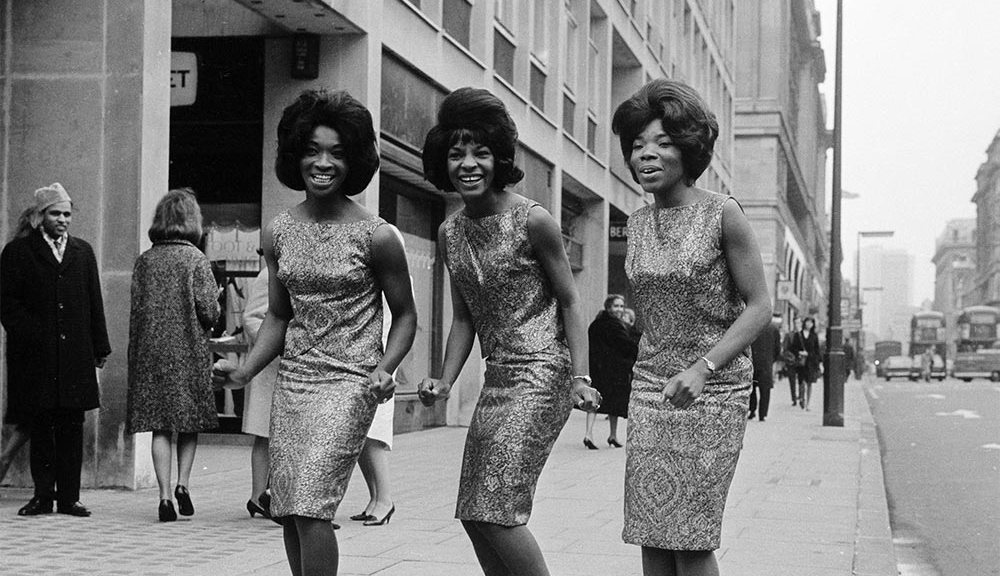
Martha and the Vandellas (Dance Party, 1964)
The original version of “Dancing in the Street” is a classic for a reason. Actually written by Marvin Gaye, the song exhibits all of the qualities of a great Motown song. The chorus is uplifting and catchy, the lyrics are simple yet nuanced, the harmonies perfect, and the performance’s energy is contagious. And those punchy horns! Martha Reeves delivers a fantastic vocal; you can’t help but want to join her invitation out on the block. You can imagine the fire hydrants pouring water onto the hot asphalt, kids and dogs running around, and everybody having a great time. The song apparently went on to become an anthem during the civil rights movement – note how Reeves calls out predominantly black cities across the country: Chicago, New Orleans, NYC, Philly, Baltimore, L.A., and you can’t forget the Motor City Detroit! It was a call of solidarity, of unity and celebration, and in an oblique way, a call to action. It’s almost impossible to say that this isn’t the best version of the song. A stone cold classic, there’s positivity in it that calls across the generations. No wonder it went on to be a common thread through the rest of music history.
The Kinks (Kinda Kinks, 1965)
British Invasion stars The Kinks were the first to cut their own cover of “Dancing,” only one year after its original release. Their version lacks the defining horns, or really any musical flourishes, and is instead driven by Mick Avory’s drum beat. You can’t say that about many Kinks songs, so this one is definitely atypical. Frankly, this isn’t a very good cover, as Ray Davies sounds uncommitted on the vocals, and there is really nothing to help this track stand out. I wonder if the Kinks, the most English of all of their peers, just didn’t quite connect with the distinctly Black American feeling that Martha and the Vandellas tapped into. I have a hard time imagining anyone dancing to this. In any case, the Davies brothers would soon develop into great songwriters in their own right, and it became clear that Motown was not in their wheelhouse.
The Who (BBC Sessions, 1966)
The Who must have paid attention to the failings of their countrymen in The Kinks, because when they decided to perform “Dancing in the Street” for a BBC radio broadcast, they crammed all the energy possible into their two minutes. Roger Daltrey sings with much more soul than Davies, and the harmonies from Pete Townshend and John Entwistile make it sound more like the original. Keith Moon is pumping it behind the kit as usual, and by the time Pete launches into a mini solo during the outro, you really are moving. The Who never officially recorded the song for release, so it’s clear they never personally latched onto it (probably because Townshend was already following his own muse). But as a last gasp of their “maximum R&B” phase, it’s a hidden gem.
The Mamas & The Papas (The Mamas & the Papas, 1966)
The Mamas & the Papas put out this pretty well known version in 1966. Mama Cass delivers typically powerhouse vocals, and overall it’s a pretty fun reading. The addition of electric guitar and keyboard make it sound more of its time than the original timeless version, but that same swirling atmosphere perfectly compliments the high times currently being enjoyed by the band on the West Coast. That said the very end of the song, in which they use goofy voices to name random cities not listed in the original recording, cheapens the whole thing and shows that these four white kids missed one of the points of the song. Nonetheless, the energy and Cass’s voice make this the best cover version of the Sixties.
Tages (Tages 2, 1967)
…Yikes. I admit I literally had never heard of the Tages until researching for this article. Apparently they were a Swedish rock group that clearly was glomming on to what was going on in the rest of the pop music world. For their turn at “Dancing,” they lead with a pretty jarring drumroll then go into the most by-the-number performance imaginable. Actually, the kind of funky, martial drum beat is the best part of the recording, though I tuned out about halfway through. It’s just generic. Sorry Tages, but I see why you never caught on.
Little Richard (The King of Rock and Roll, 1971)
OKAY LITTLE RICHARD, I SEE YOU!! I actually had pretty low expectations for this, as Little Richard’s output after his initial 1950s run is spotty. But I shouldn’t’ve doubted the man who helped originate the form; just as “Dancing” was a bad cover choice for The Kinks, it’s a perfect selection for Little Richard. He essentially uses it to launch a funky extended vamp that goes on way longer than any other version on this list. He only occasionally references the original melody, but it works. Boy does it work. If you can’t dance to this I don’t think you have a pulse.
Grateful Dead (Terrapin Station, 1977)
Those in the know know that the Grateful Dead in the studio and the Grateful Dead live were often two different beasts. The band began performing “Dancing in the Streets” in the Sixties, and it was the perfect example of them taking a popular song and warping it to fit their psychedelic dance party sound. It would often stretch to 15 minutes, with plenty of funky jamming to keep you moving. However they didn’t end up recording it in the studio until 1977, and it showcases the worst of their studio tendencies. The super disco sounding horns are overbearing, and in an apparent effort to be more commercial, they didn’t include any extended instrumental. However I do like Donna Jean Godcheaux and Bob Weir’s harmonized “dancin’, dancin’ dancin’ in the streets!” arrangement. Overall it’s a shame, because even though the Dead are one of my favorite bands, this version is not it.
Van Halen (Diver Down, 1982)
Heck yeah, this is more like it. I’ve heard some people say that this synthesized Van Halen cover is corny, but honestly I love it. By the Eighties, “Dancing in the Street” had become a modern standard, and VH’s reading is both cheeky and respectful at the same time. Much of this is thanks to David Lee Roth, the ultimate cheesin’ frontman, who just genuinely wants everyone to dance. The pop-hard rock styling makes it hard to refuse, even without Eddie’s shredding guitar solo (which of course he throws in anyway). It’s a lightweight cover, for sure, but oftentimes rock is the most fun at its most tossed-off.
David Bowie and Mick Jagger (1985)
Every now and then, a cultural artifact is created that is so singular, so of its time, and so bafflingly indescribable that it eclipses time and space to become untethered from any and all associations with which one may attempt to contextualize it. Such is the “Dancing in the Street” music video by David Bowie and Mick Jagger. It wasn’t recorded for an album, or any commercial tie-in. They did it just because they felt like it, and now we have it for the rest of time. When someone says “the Eighties,” this has to be one of the top images that come to mind. Talking about the actual musical qualities are immaterial at this point. (Let’s face it, the two stars have enough charisma to carry anything, but the over-production does the song no favors.) What we will talk about is the music video. The outfits? The dance moves? The homoeroticism? In the words of Rick James, “cocaine’s a hell of a drug.”
Myra (Myra, 2001)
Wow. I have a lot to say about this. Apparently, this version was recorded for the soundtrack to Disney’s film Recess: School’s Out, based on their animated TV show Recess (a great underrated show if there ever was one). That factoid initially led me to assume the worst for this cover, but it was surprisingly fun. They pull from the late-Nineties/early-Aughts trip-hop boom, with an electro beat and sitars for the main riff. Myra is obviously a wanna-be tween star that Disney was pushing at the time, but for what it’s worth she sings her heart out. Also, I am here for the trippy music video. I’m not going to be bumping this song any time soon, but I probably would have thought it was cool when I was 11.
The Struts (2019)
I’ve heard of The Struts as a neo-glam band, and I can tell from this song that they’d probably be lots of fun live. I need to look up their stuff. That said, for this cover they do their version of Van Halen’s version of “Dancing,” complete with the distinctive keyboard line looping throughout. It’s funny to think that a good-natured 1982 send up of a twenty-year old classic would itself become the standard that a new generation covers 37 years hence. Wow, it’s been thirty-nine years since Van Halen released Diver Down?? Where have all the good times gone, indeed… The fact that The Strut’s music video for this song is essentially a long-form Dodge car commercial is pretty lame, and very not rock and roll.
Conclusion
So there we have it. “Dancing in the Street” went from a genuinely exciting and revolutionary single to a commercial jingle twice removed from its original source. Along the way it was covered by a myriad of rock and pop acts, usually with the good natured intent of inspiring unity and fun. Is it cynical of me to say that it’s the nature of all art to either be forgotten or become commercialized? Perhaps, but that’s clearly what’s happened here. Martha and the Vandellas’ original call for celebratory togetherness was so pure and true that it truly did make a mark on culture. Now, advertisers pick up on that universal recognition and attempt to connect the song’s good feelings to their product (in this case, Dodge). It’s inevitable, and let’s be real: every hit song we love has probably been used to sell something at some point. If rock and roll is American, so is capitalism.
But one other thing cannot be denied: regardless of how we may feel about how a certain version of a song is used or not, we can’t help but acknowledge its greatness. “Dancing in the Street” has lasted because it’s a great song that can somehow encompass celebration and positive revolution all at once. It’s the sound of communal triumph, and I feel like every version that we listened to could signify such in their own time. I’m sure that there will be more versions of “Dancing” to come in the future – in fact, I hope there will be, because that would mean that there are reasons to dance.
 Then Play On