
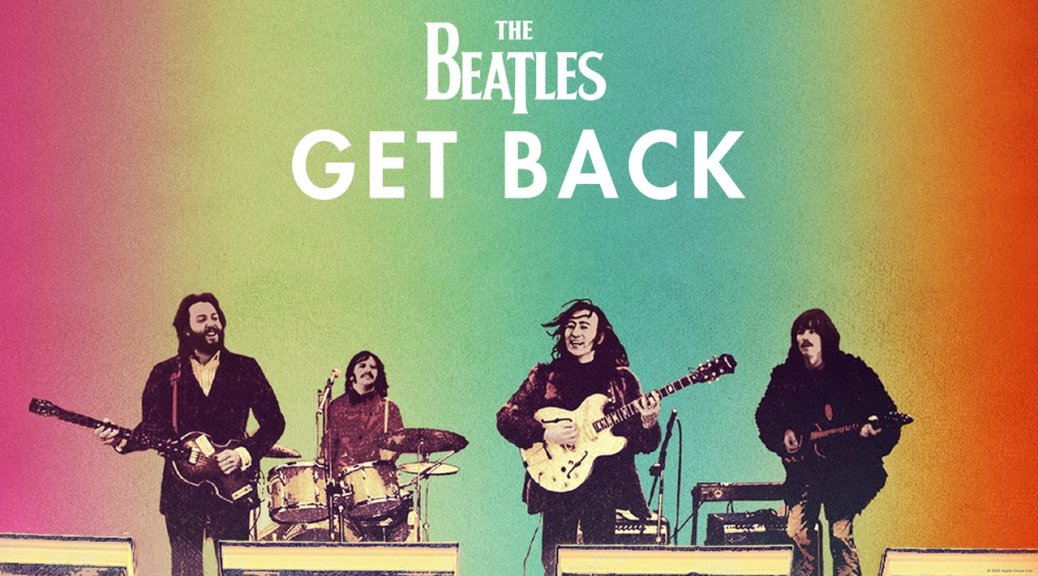
[This contains spoilers, in the sense that I talk about stuff that happens in the Get Back documentary. I don’t think this takes away from the fun of actually watching it as there is no “story” to spoil. Yet if you want to freshly encounter everything on your viewing, be warned.]
Everything about the story of The Beatles is legendary. Their early days playing dive bars in Liverpool and Hamburg, their meteoric rise to fame and frenzied arrival in America. Their record breaking concerts, their extraordinary studio creativity. Even the members themselves stand like caricatures in our cultural imagination: John Lennon, the peace loving hippie with a piercing wit who also battled personal demons that haunt him and his public perception. Paul McCartney, the eternal optimist, the people pleaser, the only one who wanted to be a star, and probably one of the greatest musicians of the 20th Century. George Harrison, the sensitive one, drawn to spirituality and displaying a wry aloofness. Ringo Starr, the goofy everyman, along for the ride and loving every minute of it. Oftentimes these personas obscure the fact that The Beatles were actually people, living their lives one day at a time, with all the tedious minutiae that entails. We fans have read about events and moments in their career again and again, always yearning to be a fly on the wall, or to just be able to hang out with the band for one day in the studio.
Now, with Disney+’s Get Back documentary, we get all of that and more. The month in question is January 1969, and the record that eventually resulted from the sessions is Let It Be, not released until a year later. By the time it saw the light of day, the band was barely functioning, and by the end of the year they would formally disband. As such, the January ‘69 sessions have long been thought to have been contentious – the lads were at each other’s throats, they couldn’t decide what they wanted to do, wouldn’t compromise with each other. That’s why the tapes were shelved until Phil Spector was brought in to gussy them up for release. Let It Be was originally received with a shrug from critics; they saw it as a middling let down after the spectacular Abbey Road. But of course, Let It Be really came before Abbey Road, and with time fans have come to love it as much as any other release from the Fab Four.
That’s just the background – what is Get Back actually about? Here it is: after several months of inactivity the band is pressured to put out a new record. They are also contractually obligated for one more movie, so see this as a good opportunity: director Michael Lindsay-Hogg will set up cameras in a soundstage, they write and record a new setlist of songs, then perform them to an audience in their first live appearance in more than 2 years. The performance will be released as their next album, and the footage will be assembled into a “making of” documentary.
LONG story short, things didn’t quite work out as planned. Lindsay-Hogg’s resulting feature-length documentary was considered a dud. It has not been released since its original run in 1970. Thankfully, Lindsay-Hogg had recorded something like 160 hours of audio and video footage. All that footage sat in a vault until a few years ago, when director Peter Jackson (best known for his legendary filmic adaptation of The Lord of the Rings) sorted through all of it and assembled it into a three part, 8 hour long docuseries.
The result is an embarrassment of riches. There is so much to say and so much to consider, that I almost don’t know where to start. First off, let me just say that even for a Beatles fanatic like me, it can grow long. The full documentary is organized day by day. When footage from one day ends, it shows a calendar moving to the next date. It’s all very straightforward with no editorial flash. Each episode is about 2.5 hours long, and I typically watched them in 1 hour chunks. The footage is very raw – much of it is straight up watching the guys repeatedly run through the same numbers as they learn them and figure out how each is going to go. Especially in the beginning, there is a lot of “hurry up and wait.” You forget just how much effort and time goes into creation – they didn’t just show up and magically record the songs as-heard on record. Casual fans will certainly get bored at parts.
Yet, it is this daily minutiae that makes the project so fascinating. We see the Beatles live their lives, talk and joke and collaborate and get bored and drink and smoke and smoke and smoke and smoke (honestly it’s crazy how much everyone smokes constantly).
In order to not make this review become a book, I’m going to break my thoughts down into bullets to cover them efficiently:
- It is genuinely amazing to witness how truly talented – nay, supernaturally gifted – Paul McCartney is. He sits down at the piano to explain it to a visitor, and effortlessly plays a beautiful piece of music off the dome. When finished, he shrugs, “that’s all it is really, you just learn the notes.” The visitor looks on in bewilderment. Seriously, Paul has one of the best singing voices in music. It’s strong and versatile and tuneful. The way he can play every instrument and make it look effortless. The way he can pull songs out of thin air.
- On that note, everyone online is already talking about the “Get Back” scene. One day in the first episode, John is late for rehearsal, so the three others are sitting around waiting. Paul starts absentmindedly strumming on his bass. He hums along to the riff he’s playing, and slowly, surely, you start to recognize the melody to what would become “Get Back.” He starts to ad lib words, form the composition. Once it dawned on me that I was literally watching the birth of one of the most famous rock songs in history, out of the blue by one of the great music geniuses, tears formed in my eyes. It’s pure magic.
- Then there’s John. He really was such a fascinating character. There’s so much that’s built up around him, both good and ill, that it’s hard to get a read on what he was actually like. He’s clearly extremely intelligent and artistically talented, but often comes off as if he himself is playing the “John Lennon character;” like he knows how everyone expects him to act so has to fulfill it. He seems very detached in the first episode, but once they switch from Twickenham soundstage to Apple Studios and they start recording in earnest a switch seems to be flipped and he’s much more about it. With John, more than any other, you get the notion that he’s burnt out on the fame and pressure of being a Beatle. He wants to do his own thing and explore other avenues, but still feels obligation to the band that he started.
- Secondly, it seems that John has been extremely underrated as a guitar player over the years. Seeing him improvise solos in the studio, or see how his rhythm drives the actual compositions is illuminating. It isn’t as technically sound as George or Paul, but his energy and approach feels like an unwitting harbinger of the alternative rock that would come decades later. There’s a couple times where different combinations of the band jam with Yoko doing her screeching vocalizations over top, and they really do sound like noise rock pioneers. If only they had released some of that stuff. (Granted, John and Yoko did, but under their own names, causing it to be received differently at the time.)
- And then we have George. George is actually the main driver of drama throughout the doc. I’m going to have to go into sub-bullets for this one:
- George is my favorite Beatle. He always seemed so laid back and cool, with a subtler wit and sense of style than the others. I also appreciate his spiritualism which gives his songs a unique sense of depth. Despite his clear worth, the documentary reveals a man struggling with self-esteem issues. Much has been said of how he felt stifled by the brilliance of the Lennon/McCartney team, and you can see that here. But it’s also clear that the other guys valued him. One of my favorite exchanges is when George is having trouble nailing a guitar part that he feels should be really fancy. He laments, “You need Eric Clapton.” John looks up and replies, “No, we need George Harrison.” Daawwww.
- Early on, as the band is putting together “Don’t Let Me Down,” Paul keeps stopping them to work out what everyone is going to play. George, on the other hand, advocates just playing through it and feeling out how it should sound in the moment. The confrontation is electrifying. They don’t hate each other – clearly friends – but have different creative processes. George feels like Paul is bossing him around. Paul, for his part, recognizes that he kind of is but doesn’t know how to be any different. This exchange more than anything underlines why they went their separate ways within a couple years.
- Then we have the big cliffhanger of Episode I, in which [spoiler alert?] George leaves the band. This prompts some soul searching and questions about the future. Of course, after a couple private band meetings (oh if only we had footage) he agrees to come back.
- Later on, in Episode 3, George talks about wanting to record a solo album of songs he’s written that he feels don’t quite fit the vibe of the Beatles, while still being in the band. It would be a side release. John seems really into it. George shows one of the songs, and it’s “All Things Must Pass,” the title track of his debut post-breakup solo album. (All Things Must Pass is considered by many to be the best Beatles solo album of them all….I don’t know if I can make that call, but it’s definitely HIS best, and passed only by a couple from John and Paul).
- Also I want to make a point of shouting out GEORGE’S BOOTS!! What are thooooose?! Only he could pull those off.
- After George comes back in Episode 2, John and Paul go have a private lunch in Apple’s cafeteria. The filmmakers secretly hid a microphone in a plant nearby that captures their conversation. That’s not cool of them, but I’m so glad they did. It’s another highlight of the whole documentary. The two old friends talk about how their perspectives have shifted on leadership within the band – Paul says something along the lines of “I’ve always seen you as the boss, I still do, but I feel like I’ve had to step up lately and it doesn’t feel right.” They talk about underappreciating George, what they want to do next, how they feel about the current project. So much ink has been spilled about the partnership between the two men, and here we hear them working it out after things have been put through the fire. It’s another moment of electricity, alone worth the price of admission.
- Aren’t we forgetting someone? Ah yes, Ringo. Look, there really isn’t much to say except: Ringo may be the chillest person to ever live. No matter what happens, he’s always there as an affable and mediating presence. He lays down his parts and never complains. It’s obvious how no matter the bitterness that existed between the three others post-breakup, they all stayed friends with Ringo. He just seems like a legitimately cool dude. God bless him.
- One thing that’s very interesting is that almost every day, the four arrive in the same order to the studio. Ringo is there first, then Paul. George consistently shows up a little late. John rolls in very late every day, but is ready to get right to work. As for transportation, from what we see, Ringo and John have personal drivers. George drives himself, and Paul takes public transportation. Make of that what you will.
- George Martin, their ace-in-the-hole producer, is always there, but he doesn’t do much. Either by this point they’ve learned enough from him that he doesn’t have to, or he’s frustrated that they lack a clear direction for the project. Maybe a little both. If anything, the biggest contributor from the production side is a young Glyn Johns, who is everywhere in the studio helping them engineer the recordings. He should have been credited as producer. Johns also has the best collections of coats in London. The band released a “Glyn Johns mix” of Let It Be as part of the deluxe 2021 reissue. After watching this I’m interested to check it out.
- On the topic of potential Fifth Beatles, there’s the man himself, Billy Preston. Preston is brought into Apple Studio early in Episode 2 because the band realizes that to capture the new songs live, they will need a fifth person to play keyboards. Preston was a friend of the band since the early days. He played with numerous R&B and soul musicians, including Little Richard, with whom he met the Beatles back in the Hamburg days. Preston’s organ adds so much to the proceedings. At times he seems just as star struck and happy to be there as anyone would, but his positive demeanor is just what the band needs to get out of its lurch. His playing is so important in adding texture and swag to the proceedings. Kudos to Billy Preston.
- Director Michael Lindsay-Hogg comes off like a real entitled douche. He always butts in to try to get the band to do what he wants them to do for his movie. How dare he presume to tell the best band in the world how to go about creating their music?? His ridiculous insistence on having them go play in an ancient outdoor arena in Africa passes through many stages: kinda cool, impractical, annoying, pathetic.
- Ohhhh I can’t forget about the wives. Yes, behind every great Beatle is a woman who loves him.
- Linda Eastman, the American photographer who had just began dating Paul, comes around often. She seems so cool and smart and confident. By far my favorite Beatle wife. Seeing Linda do her thing is bittersweet, because while her and Paul truly seemed to be blissful soulmates, we all know that she dies of cancer in the early Nineties.
- Maureen Starkey comes by once or twice, and seems about as chill as her husband. She rocks the stereotypical Sixties style, which makes sense, as she was a hairdresser. She seems nice, and quiet, and cute.
- Pattie Boyd comes by once. She swings by the studio, says something into George’s ear, gives him a kiss, and leaves. I have mixed feelings about Boyd: she was with George from 1964-1977, and they were married for the last 11 of those years. So they clearly had a connection. But just the knowledge that she would subsequently leave him for Eric Clapton leaves a bad taste in my mouth. Although, George seemed cool with it, so I guess no harm no foul.
- Then, of course, there’s Yoko. Yoko Ono, the Japanese visual and performance artist who began dating Lennon in 1968. In fact, at one point in the series, the couple get word that John’s divorce with his first wife Cynthia is finalized, and they celebrate a bit. If anyone comes out ahead in this documentary, it’s Ono. She has long been credited with “breaking up the Beatles” because she and John literally refused to be apart. She accompanied him everywhere, and even sat in the studio with them as they rehearsed and recorded. People said this intrusion frustrated the other three, who also saw her pull John’s attention away from the band. At first, her presence seems to be the specter at the feast, but as time goes on it becomes clear that her influence, good or ill, is vastly overblown. Paul, George, and Ringo don’t really seem to care either which way about her. She never interferes at all with their process. She trades conversation with the others on occasion, but so does everyone else present. There is one part where Paul privately acknowledges that John cares more about her than the band at that moment in time, but also admits that that is more of John’s own choice than anything. Paul then jokingly laments that years down the road, people would blame her for their eventual break up when the reality was nothing of the sort. If only he knew. She was used as a scapegoat by fans, but while she didn’t help the situation, it’s clear that the break-up would have happened anyway.
- There’s a quick scene of Linda and Yoko having a conversation. There isn’t any audio, and I so wish there was. I would love to hear what they are talking about and how they relate to each other.
- Seeing video footage of their India retreat is pretty cool. Even cooler is listening to the band reflect back on the time, and wonder if they went for the right reasons, and even then, what were the positives that they got from it.
- The renowned Beatles wit is on display throughout the runtime- some of my favorites were Paul’s “Everybody had a good year…except for me and my monkey” wink back at the White Album track. Also, when they begin one run-through of “Let It Be,” Paul hits a bad note on the piano and messes up his vocals. The take falls apart, so John lets out an emphatic “What the f*** is going on…?” I laughed hard.
- On the subject of quips, I loved seeing the “Dig It Jam,” which really is as loose and spontaneous as it sounds on record. I loved seeing the actual instance of “and now, we’d like to do ‘Out the Angels Come.’” These little moments that we hear on record and imagine for years, then see in the flesh is what makes Get Back such a joy for fans.
- Watching Get Back makes me wish that there was such footage for every recording session. Knowing that this a relatively rough part of their career and resulted in a comparatively middling album, can you imagine watching a fly-on-the-wall doc on the making of Sgt. Pepper, or Revolver, or the White Album, or even Please Please Me? Ugh, I can’t torture myself with such thoughts.
The entire venture leads up to the legendary rooftop concert. With all prior plans run aground, the group decides to set up on top of Apple Corp. HQ and play a set of their new songs. The event is not only their last performance as a band, but is without a doubt one of the most famous plot points in rock history. Despite the possibility of overhype leading to a let down, the concert does not disappoint.
It is goosebump inducing to see it all go down. The surrounding streets fill with people as they hear the music cascading through London. It made me think about how fresh and exciting it was – the “rooftop concert” has become such a cliche in the decades since that it has been copied by others or served as the inspiration for any number of public stunts by artists. But this is the first. There’s a genuine sense of excited bewilderment at seeing the “reclusive” Beatles (they hadn’t performed live for about 2 years – an eternity in the Sixties) suddenly appear and bring life to the workaday streets.
The performance itself is magic. Despite weeks of second-guessing themselves and bickering, they turn it ON for the performance. You can tell they are excited to slip back in to rock star mode. When they play, really play, for an audience, it’s easy to see why the legend of the Beatles endures. Billy Preston locks into a jamming groove, Ringo holds the beat like a casual master, and George understatedly adds the perfect color. John and Paul, performing together for the last time, play off each other like old brothers. Their chemistry is palpable as they look back and forth to each other, give each other cues and trade vocals. Paul shouting into the mic to echo off of surrounding rooftops, John mugging for people watching from neighboring fire escapes. There’s a sense of real joy and spontaneity that had been bottled up for too long by the business side of the Beatles, by commercial expectations and a sniping press. If for only a half an hour, they could do what they loved again, and it’s perfect.
The rooftop concert would have gone on longer, if not for those meddling Bobbies. Peter Jackson splitscreens some of the concert with footage taken downstairs of the police arguing with Apple staff to stop the proceedings, citing noise complaints. They eventually force their way up and pull the plug. The one cop leading the charge comes off as one of history’s greatest squares. Congrats guy – you are now and forever the stick in the mud who wants to stop the Beatles. When the law finally gets up to the roof the band plays another song or so before it’s finally halted, and it’s great to see Paul glance back at the boys in blue before cheekily turning back to the mic and giving it his all. Then as everyone is ushered downstairs to face their legal comeuppance, John pulls Yoko to the side and frantically empties his pockets of…stuff…that he surely does not want the police to find on his person.
So in the end….Get Back rights some preconceived wrongs about the twilight of The Beatles’ career. They didn’t hate each other. They didn’t spend the entire sessions arguing and stabbing each other in the back. There were disagreements, yes, and they had to have a couple honest conversations, but that is what you do in creative partnerships. That is what you do with friends. There is much more time for them joking, laughing, playing together, writing songs. It just got to a point where they had to go their separate ways for a bit. Watching this, there is no doubt in my mind that they would have reunited at some point. Possibly in the Eighties, definitely in the Nineties. It makes it hurt even more that John was taken so soon. Who knows what would have happened, how many songs we were deprived of.
Yet, as I said in my ranking of all their albums, we are already lucky to have the songs that we do, and those songs will stay with us forever. In letting us be a part of the minutiae, the good and the bad, Get Back humanizes The Beatles. The documentary at once dispels the myths to illuminate the people underneath, while at the same time showing us that the art those people created is that much more remarkable for their humanity.
Rating:

 Then Play On