

The floodgates are opened, and there is no turning back. The social media mob is out in full force. Someone wrongly criticized Taylor Swift. On Tuesday, it was revealed that as part of an interview with The LA Times, British musician Damon Albarn stated that he doesn’t believe that Taylor Swift writes her own songs.
Some background. Damon Albarn was the lead singer for Nineties alt-rock band Blur, and since the new millennium is primarily known for being the lead creative force in the virtual hip-hop band Gorillaz. He’s also been part of supergroup The Good, The Bad & the Queen with The Clash’s Paul Simonon, The Verve’s Simon Tong, and Tony Allen, who played with Fela Kuti. He also put out The Rocket Juice & The Moon, a collaboration with Flea and Tony Allen, as well as a string of collaborations with various African musicians. On top of all that, Albarn sporadically releases music under his own name. Needless to say, he has had a varied, influential, and in all regards successful career in the music industry for about 30 years.
Taylor Swift needs no introduction. If you have followed anything about music or popular culture at all over the past 15 years, you know who she is. The country-turned-all-around-pop star has amassed an amazing amount of commercial and critical success on the back of her personal songwriting and stylistic evolution. She’s also just as notable for the control she exerts over her image and career compared to many other female stars, as well as several high-profile relationships and celebrity feuds. I can confidently say, with no reservation, that Swift is one of the biggest celebrities in the world, by any measure.
If there is one thing Swift’s massive army of fans, dubbed “Swifties,” will tell you, it’s that she writes her own songs. This has been foundational to her narrative and persona from the beginning, and a big reason why her success is so lauded in the mainstream. It’s truly perplexing, then, why Albarn would so confidently state otherwise.
Here’s the full excerpt of the interview in question, so you can get the entire quote:
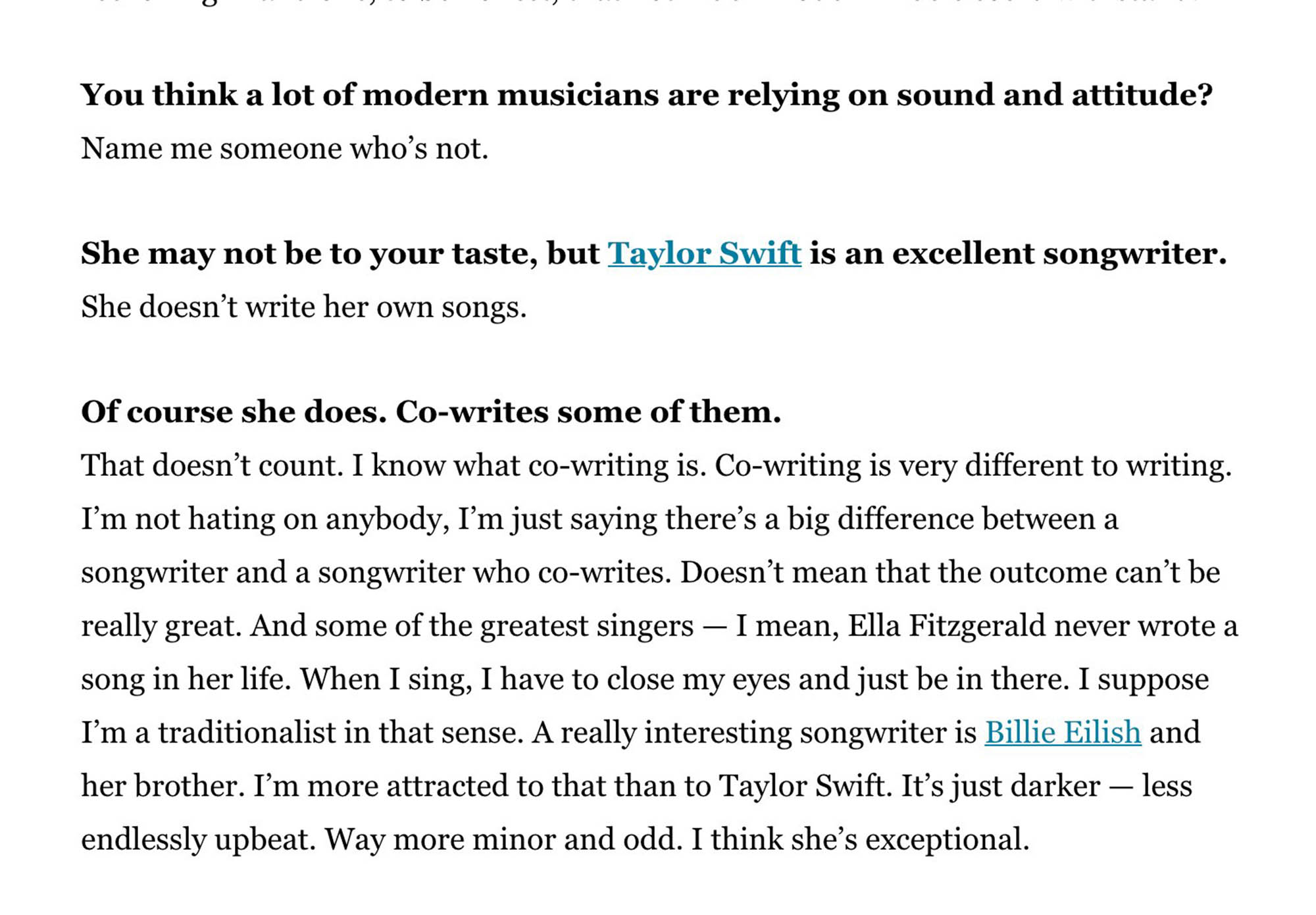
So, on the surface, Albarn’s statement is a little more nuanced than the clickbait headlines. He acknowledges that Swift co-writes most of her songs, but also posits that co-writing is very different from writing a song on your own. So, I guess by his logic, she’s not as legitimate as other songwriters. I could maybe follow that argument, if it weren’t for a few things. Firstly, he goes on to praise Billie Eilish – who is also widely known to work in close collaboration with her brother Finneas. (He even acknowledges this.) Secondly, the vast majority of Albarn’s output over the years has been as a part of bands – which are inherently collaborative! Thirdly, there have been many acclaimed artists over the decades who do not write their own material, but are still beloved for their interpretive and performative skill.
So I really do not understand where Albarn is getting off. He should have just said that he doesn’t like Swift’s music because it’s not to his taste. Her fans may not have liked that, but I bet it wouldn’t have even blown up. It would just have been his honest opinion, which you can’t really criticize. But for some reason he chose to discredit her songwriting, which is just bad form.
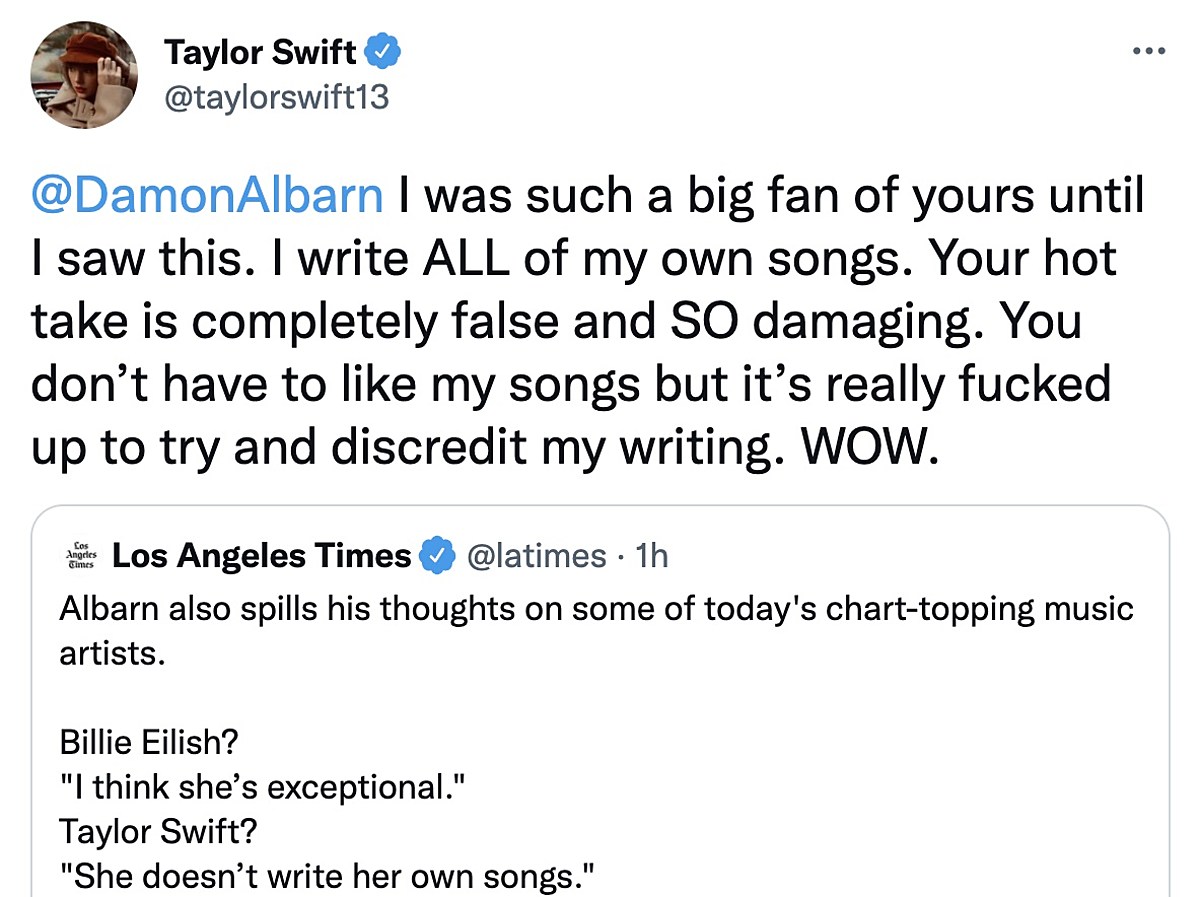
In response, Taylor put him ON BLAST on Twitter, using surprisingly strong language to let the world know that her artistry is not to be questioned:
Now, I doubt that Albarn maliciously intended to disparage Swift, and he said as much in his posted apology:

Unfortunately for him, trying to blame the reporter for twisting his words is a cop-out; we can read the transcript and it’s exactly as it reads. He should have just owned up and more sincerely apologized for his oversight. What was he thinking? Who can say?
That should be the end of it, but reader, we are just getting started. This entire situation and the attendant social media fall-out raises three issues that I’m eager to address: the definition and role of “songwriting” as part of the broader creative process; casual misogyny in the music industry; and the cult of personality around Taylor Swift.
Before I dive into the deep end, I want to be transparent. I’m not a fan of Taylor Swift’s music. I don’t actively dislike her – I know her popular singles and like several of them well enough. I especially enjoy her 1989 era. The production has a warm, nostalgic feel and the songs are all oh-so catchy. I also appreciate the more folk-oriented turn of her last two records. That said, she doesn’t connect with me like she does with so many others; her lyrics and vibe aren’t all that interesting to me personally. I can’t get myself to invest in listening to a full album, despite the fact that I often say I intend to do so. Overall, I’m rather indifferent to her as an artist. Beyond the music, while I respect her success, there are some aspects of her public persona that rub me the wrong way, which I’ll get into later.
As for Damon Albarn, his music is much more up my alley. The Gorillaz are one of the most interesting projects of the modern era, and they continue to put out cool stuff. In fact, their latest album appeared on my best of 2020 list. The visual aspect of the Gorillaz helped create one of the first “expanded universes” in the music world, and they were way ahead of their time in regards to blurring (no pun intended) the lines of creative representation in art.
Speaking of, we’ll turn to his time in Blur. In the United States, Blur is mostly known for their “Song 2,” the grungey riff rocker with the “woo-hoo!” chorus. However, “Song 2” is not indicative at all of the majority of their career. They were one of, if not the, biggest bands of the Britpop era. Along with Oasis, Pulp, Suede, and forerunner The Stone Roses, Blur helped to revitalize British rock in the early to mid 1990s and became a major part of the decade’s culture. The reason they didn’t translate as well across the pond, I think, is because Albarn’s songs are extremely English in both voice and themes. Out of all of the classic rock forebears, Blur is most like The Kinks in this regard: The Kinks intentionally focused on explicitly British topics which led them to be critically acclaimed yet less commercially successful worldwide. Both bands are very underrated in our current time and place.
That’s not to say I’m a huge Albarn fanatic. I like his music (certainly more than I do Swift’s) yet at the same time he comes off as very pretentious. His music with Blur is good, but doesn’t hit me the same way as my favorites do. For the inevitable comparison, Blur’s principle rivals Oasis had much more success in America, and I like them more as well. While you can tell that Albarn and his bandmates are arty upper class guys writing character studies and experimenting in different production styles, the lads in Oasis are just a bunch of middle-class blokes who write big obvious guitar songs. Yet these songs have a heart-on-sleeve sincerity that is impossible to deny. Add in their Beatles worship and psychedelic flourishes, and it’s much more up my alley. Blur had the brains, but Oasis had the heart. ANYWAY, I digress.
The first aspect of this debate that I want to address is, as I said, the definition and role of songwriting in the overall creative process. Over the past 50+ years, writing one’s own songs has come to be seen as the purest hallmark of artistic integrity. Not writing your own songs is seen to be a mark of superficiality. In short, phony pop stars use songwriters to chase hits, real artists follow their own muse.
But it’s not so cut-and-dry. Recording music is rarely a solitary venture. Predominantly self-contained artists and bands have worked with outside songwriters for decades when they need help focusing their ideas. On the other hand, many big name pop stars who work with dozens of songwriters still have some level of input towards the creative direction of their output. Unless the artist self-produces, then there is at least a producer who can have a significant influence on how the final recording sounds. Does that contribute to songwriting?
Yet it goes deep still. When talking about collaborating, what exactly do we mean? Does someone write the lyrics, and another makes the arrangements? Or do multiple people combine their talents in all areas? For example, David Bowie wrote all his songs, but he didn’t play and instrument. He collaborated with other musicians to craft the sounds in his head. Does that lessen the achievement of his craft? It’s possible that one person could do the bulk of the work on creating a track, then the singer changes one or two words to fit their liking and receives a songwriting credit. Generally, if a recording is credited to a band I consider it to be “by them” if one or some combination of members of the group contribute.
Many people seem to consider artistic creation in any medium to be akin to spontaneous, divine inspiration. But as The Beatles Get Back documentary demonstrates, real creation takes hours of work, trial and error, and editing. It’s okay to get advice and help from others as long as you are open and honest about it.
Which brings us back to Albarn and Swift. I took a glance at the credits for every Taylor Swift album (as cataloged on Wikipedia). My ballpark estimate is that about 70% of her songs have between 1 to 4 additional credits beyond her name. Yes, she is the major throughline throughout it all, but she is by no means the only contributor. So, in actuality, what Albarn said actually is true.
But let’s look at his songs. The vast majority of his tracks credit multiple people too. The Blur and The Good, The Bad & the Queen tracklists are all credited to the members of each band. Fair. The Gorillaz albums are loaded with outside names beyond Albarn’s. True, Gorillaz is by design a more collaborative project, but again – what is his point in picking on Taylor about this? Then, finally, even his latest solo album gives his backing musicians songwriting credits.
All this is to say that while I do put high value in songwriting (and the more directly the artist is involved, the better) it’s not the be-all-end-all of artistic worth. That leads me to the next point: the cult of personality around Taylor Swift. It makes sense that a star of such magnitude would have legions of devoted fans, but this very conceit contributed to this controversy blowing up far more than it probably should have. The LA Times CHOSE to post that excerpt precisely because they knew any slight against Swift would make headlines. Sure enough, she reacted exactly as they would want, and it turned into a firestorm. Her tweeted response received 21,400 comments, 172,000 retweets, and 710,000 likes. That’s just on one website – consider conversations on Facebook, Instagram, news comment sections, and even this blog.
Now, one of my biggest longtime gripes with Taylor Swift is that, for much of her career, she has come off to me as fake. I don’t mean fake to say that she doesn’t write her songs, that her lyrics aren’t authentically her. I mean that her entire public persona is clearly tailored (no pun intended) to fit the narrative that she is this sweet, good natured girl who cares and feels deeply. Now, I don’t know Taylor Swift personally. She may actually be a very nice person who cares deeply. But when you purposefully portray yourself as such at every opportunity, it starts to seem insincere. No one is truly that naive. Every time she wins an award (which is often) she acts extremely surprised and shocked. Taylor, after a while, is it that surprising to recognize that a lot of people like your music? False humility is not flattering. The entire feud with Kanye West and Kim Kardashian (which I’m not going to get into), then her subsequent attempt to make it seem like they forced to break bad with the Reputation album just seemed so lame and try-hard.
Why do I bring this up? Well, because, to someone who isn’t a Swiftie (like me, or, perhaps, Damon Albarn) it’s not hard to believe that her music, like the extension of her public persona, is plastic.
Most of the comments on the tweet fall into 4 categories:
- Asking who Damon Albarn is / proudly proclaiming ignorance of him
- Calling Albarn a misogynist
- Calling Albarn’s music trash and claiming he will never have the influence that Swift’s music does
- Stating that Swift is the best songwriter of her generation/one of the best alive
Even though I agree that Albarn’s comments were way off base and inappropriate, I do have some issues with the sentiment behind these comments. Firstly, if you don’t know who he is, that’s on you. Perhaps broaden your music knowledge past the most mainstream singer in the world.
Secondly, I do believe that his comments did play into the longrunning casual misogyny in the music industry. There is a long sorry tradition in the world of pop music to question a female artist’s skill and integrity. It usually falls back on the trope that because they are a woman they aren’t as serious as those real, male singers. This is obviously bunk, and I don’t need to go into the countless examples as to why it is so. I know that Swift has had to fight harder for respect and creative control specifically because of her sex. At the same time, while Albarn did inadvertently draw from this mindset, I’d hesitate to say that he himself is an explicit misogynist. While it is important to call someone out on problematic thought patterns so they can examine why they may think such a way and learn and grow, attacking someone for what can generously be called a misunderstanding is a tad harsh.
Thirdly, calling his music trash is nothing other than pure stan culture flaming. Saying he isn’t influential is patently wrong; I’ve already described how Blur was totemic to 90s music, and Gorillaz were ahead of their time in the 2000s. Although the tweets claiming that he’ll never have the same level of reach may in fact be true. Taylor Swift has 54,092,571 monthly listeners on Spotify. All of Albarn’s projects combined tally up to 23,490,056 monthly listeners, less than half of Swift’s. Considering that both Blur and Gorillaz are extremely popular bands, the disparity is insane. It speaks to how huge Taylor Swift is on a global scale.
And I think she really will have a bigger long term impact on the music industry. But it won’t be for her music. It will be for how she successfully transitioned from the world of country to the world of mainstream pop, has carved out an empire, and wrested control of her publishing rights from record labels and producers that were profiting off of her work. This is all a good thing. Yet since the argument inevitably devolves into who is a better musician, I don’t think her stans have the strongest legs to stand on. Yes, yes, SHE WRITES HER OWN SONGS. She is canonized by fans and the media as this revolutionary artist for doing exactly what hundreds and hundreds of other singers-songwriters have done for decades. I’m not going to wade into the argument of whether she’s the best of her generation, that’s subjective. BUT THE BEST ALIVE?? Come on… Writing your own songs is commendable, but it isn’t the only thing. They also have to be good, and performed well. I could write a collection of songs myself as well. They wouldn’t be good, but they’d be songs. (Okay, that’s not true, I have enough self-confidence to think that a few of them would be decent. But I digress). My point is, Taylor writing her own songs does not alone make her immune to criticism. Personally, I find her songs to be generally pleasant but by-the-numbers.
Funny thing is, I guarantee this will color Albarn’s public reception for the rest of his career. Such is the power of Swift. Which is a shame, as, like I’ve said, his music is pretty good. But from now on there is a large swath of the population that is predisposed to hate him, and, by consequence, everything he puts out. You could say he brought this upon himself (which would be true) but as we’ve established before, he seemed more misinformed about the level of her creative contributions than outright hostile against her.
Oh well. The court of public opinion has spoken. Albarn is now a pariah, and for better or for worse, Taylor Swift has vanquished another enemy. I just wish that the narrative was a little more nuanced. Like my opinion: it’s possible to call Damon Albarn out on his untrue and dismissive statement while still liking his music and appreciating his legacy; and it’s okay to respect Taylor Swift as an artist without necessarily being a fan of her art.
 Then Play On