
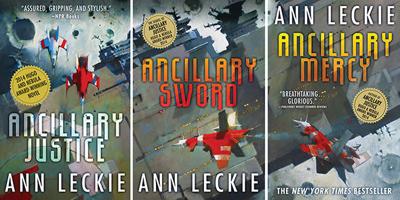
While Then Play On is first and foremost a music blog, I’ve spilled plenty of ink on my thoughts on various movies and television shows. In the same spirit, I’ll occasionally write about a book or book series that particularly stands out to me, and tell a little about what makes it so worth checking out.
As I’ve made clear before, I’m a big fan of science-fiction. Not only do the often futuristic and astral settings make for some cool stories, but the genre is particularly adept at investigating nuanced and far-ranging ideas in novel ways. At the same time, so much of popular SF falls into the same cliches that have been explored for decades by more inventive writers. When someone comes along with something truly creative, you can’t help but take notice.
Such is the case with Anne Leckie’s Imperial Radch trilogy. The series has been completed for six years now, but I read through it over the period of the past couple years, with a few other books in between each title. The trilogy is imaginative, challenging, and fun; it examines thought-provoking themes while still telling a gripping space opera.
The first novel, Ancillary Justice, introduces the reader to its protagonist and narrator, Breq. Breq is, without putting too fine a point on it, a spaceship. Although not really. You see, the story of Ancillary Justice takes place in the far, far distant future. Planet Earth is a barely remembered legend that is hardly mentioned over the course of the narrative. Instead, humanity, now known as Radchaii, has spread out across the galaxy as an empire. The Imperial Radch is extremely expansionist and has been for centuries. Their warships are built with advanced artificial intelligence that give them personalities and the ability to act as an independent entity (with programmed safeguards for putting the safety of its crew, officers, and captain first). The unique twist here is that each ship has hundreds of what are called “ancillaries,” human bodies augmented by cybernetics and controlled by the ship. This gives the ship the ability to be everywhere and see everything at once, including being planetside during a campaign while also in orbit above it. Breq formally was the giant dreadnought Justice of Torren. Through a series of events that I won’t spoil, Justice of Torren is destroyed, except for one ancillary. This ancillary contains all the information and memory of a centuries old space battleship – this is Breq.
The initial throughline of the novel is that Breq intends to enact vengeance on those responsible for her destruction and the death of her captain. This includes, the reader quickly finds out, is none other than the Lord of the Radch herself, Anaander Mianaai. Not only is the killing of the emperor an obviously extremely difficult and dangerous task, but it’s made even more challenging by the fact that Anaander has dozens of clones of herself, so she is able to rule the entire galaxy at once.
I know all of this seems like some really wacky stuff, yet Leckie’s triumph is that all of this is made extremely personal. Outside of the galactic stakes of the narrative, the story is really about Breq wrestling with questions of her own identity and purpose. Becoming a singular entity and having to decide how to best use her knowledge and power – in effect, how to become her own person – is extremely effective. She must face the ethics that she was instilled with as a ship with the morals that she builds for herself as a “person” on the ground. One of the ways that Leckie accomplishes this is through her protagonist’s relationship with Seivarden, a snooty former Radchaii officer who, through a series of events, is stripped of her rank and reduced to a destitute drug addict. Over the course of the trilogy Seivarden becomes Breq’s most trusted ally, yet must conquer her own demons. The clinical Breq and moody, sarcastic Seivarden play off of each other well, and they help bring out the best potential in each other.
The second book, Ancillary Sword, finds Breq newly in command of a space station that orbits a colonized planet. The narrative is more personal than the first. She must deal with the layered politics of the station administration, residents, and native planet down-well, plus continue to advance her own personal mission. While a shift to a smaller scope made me at first think it was a lesser work, by the end of the novel I was on the edge of my seat. The way all of the plotlines and characters come together in a highwire climax is amazing.
The final book in the trilogy, Ancillary Mercy, is probably my least favorite. I still enjoyed it a great deal, and it did serve as a solid conclusion to the series. Yet I feel like it lacked the highs of the first two. The climax really comes more toward the middle of the book, with the back half serving as a resolution to the entire series. That said if you read the first two, you won’t be able to not read Ancillary Mercy, as the momentum of Leckie’s writing compels you to see how it all ends.
While the main theme of the story, as I mentioned, is to examine the nature of consciousness, Leckie also plays with gender identity. In the world of the Radch, all people, regardless of biological sex, use “she/her” pronouns. It’s never really commented on or explained in-universe, but at one point it is revealed, while speaking a non-Radchaii language, that Breq is indeed a female and Seivarden is male. Yet every other character is referred to as “she,” and only physically described in gender-ambiguous terms. This forces the reader to accept that gender, as we conceive of it in the real world, is not important in determining the essence of a person. As I read and pictured everything in my mind, most characters did end up being vaguely feminine, a few more were masculine, and others truly non-binary. This was just based on how they were characterized, and it made for a sometimes confusing yet ultimately enlightening reading experience.
Outside of the big themes, Leckie has fun with some sci-fi tropes. Firstly, the ancillary system allows for some very cool narrative structures. Especially in the first one, during flashbacks to Breq’s time as Justice of Torren, she witnesses several events at once through her different bodies, and it all comes together to make some truly suspenseful action. The main alien species, the secretive Presgar, are the only faction in the galaxy that is stronger than the Radch, and haunts the series like boogeymen until the third book, in which their presence becomes much more immediate. Then there’s the race called the Rrrrrr. The Rrrrr seem to be a sort of knock-off of Star Wars’ Wookies, but I love how Leckie takes their growling-and-guttural-roars-as-language much more literally.
I’m not the only one who appreciates the series. Ancillary Justice won the 2014 Hugo Award for Best Novel, as well as the Nebula Award, Arthur C. Clarke Award, and BSFA Award. Ancillary Sword and Ancillary Mercy both won a Locus Award and were nominated for Nebulas. So don’t take just my word for it: these books are good. I think what resonated with readers was the combination of a truly unique world and premise, tautly paced action, emotionally resonant story resolutions, narrative kismet, and the ultimate message of human connection. I’m a sucker for the sort of romantic, humanistic notions of determination and empathy, and this series offers that up in a way that doesn’t feel condescending or contrived, but earned and meaningful. In 2017 Leckie published a stand-alone novel that takes place after the series in the same universe but is narratively unconnected with the story of the trilogy. I’m definitely going to track it down. And if you are looking for complex science-fiction that makes you think, thrill, and feel in equal measure, I highly recommend tracking down the Ancillary novels.
 Then Play On