
Welcome to my first ranked list! I plan to present many such lists in the future, as they are always a fun challenge for me and stir up interesting conversation and debate. Please keep in mind that, as with everything on this site, it is based solely on my opinion and does not reflect some universal mandate.
The inaugural listicle is going to be my top 15 bassists. The topic has been spurred on due to the unfortunate passing of Yes’ Chris Squire, who surely appears here. It got me to thinking about the roll of the bass guitar in rock music. It obviously doesn’t receive the glory of the electric guitar, and bassists are usually relegated to secondary members on stage within the collective cultural consciousness. Of course, this couldn’t be further from the truth – the bass is a vital part of any ensemble. It provides the rhythm, the deep bottom end that gives music its power and inspires people to move. It can serve as a counterpoint to the main melody. Finally, there are lots of bassists that have left their unique mark on the instrument and the world of music. Here are my favorite, ranked from 15 to 1.
Note: As per the main breadth of this blog, I am going to focus only on musicians that can fit primarily into the broad spectrum of “rock” music. As such, there are some fantastic players inherently left off, such as Charles Mingus, James Jamerson, Robbie Shakespeare, Jaco Pastorious, Victor Wooten, and Aston “Family Man” Barrett. Also, this isn’t necessarily saying who is all-around “better;” rather it is my preference ranking based on their style and skill.
15. Jack Bruce
The bassist/singer of the original supergroup Cream, Bruce wasn’t the showiest musician of all time. He left the solos up to his bandmates Eric Clapton and Ginger Baker. Yet he did provide an essential bluesy rock with which to anchor the group’s explorations. After the band’s acrimonious dissolution, he dipped his toes in the jazz world and brought some of the swing back to his own hard rock. Here’s a sample with Cream’s “Politician” and “Born Under a Bad Sign.”
14. Juan Alduerte de la Pena
The bassist for The Mars Volta, Alduerte de la Pena brought a sophisticated jass underpinning to the frenetic extremes of Mars Volta’s sonic stew. While he didn’t have a flashy personal style, he could shred it with the best of them, best exemplified by the intro to the apocalyptic Latin stutter of “Day of the Baphomets.”
13. Cliff Burton
No list would be complete without Metallica’s founding bassist Cliff Burton. Even though he only appeared on their first three studio albums before dying in a tour bus accident, he did much to shape the band’s direction. Those first three albums (Kill ‘Em All, Ride the Lightning, and Master of Puppets) are arguably ‘tallica’s best, and it’s indisputable that they were not the same after his death. Burton’s base lines are often buried underneath James Hetfield’s riffing, but his complexity and vision helped push the band to the top of the heavy metal mountain. And don’t forget his solo song “(Anesthesia) – Pulling Teeth”
12. Geezer Butler
It’s been said that Geezer Butler invented heavy metal bass playing. As his band Black Sabbath was the de facto first metal band, this isn’t too far from the truth. Yet his basslines still hold up today. He provided the crucial underpinning to Tony Iommi’s guitar that made the music so heavy, and could take off on his own flights of fancy. His work during the solo in “Iron Man” is almost better than the guitar itself. Almost just as crucially, he wrote all of the lyrics for the Sab’s original eight albums, a fact that many people often forget. So he was just as responsible for crafting their image as Ozzy Osbourne, if not more so. For maximum heaviosity, look no further than 1970’s “Bassically/N.I.B.”
11. Bootsy Collins
This is a case of my personal taste clouding my judgement. Bootsy Collins is a legend in the world of bass playing, and as a key member in Parliament-Funkadelic, went a long way in defining what we know as funk. Besides being a P-Funk All-Star, he has a solo career and collaborated with everyone from Les Claypool to Buckethead. He also has an outsized personality and stage presence, with flashy costumes and the trademarked star shaped guitar. Groove to “Give Up the Funk (Tear the Roof Off the Sucker).”
10. Steve Harris
The bassist and main songwriter for Iron Maiden since their inception in the late 1970s, Steve Harris has one of the most distinctive playing styles in all of rock: Maiden songs are almost always instantly recognizable for their galloping rhythm and forward momentum. I can’t imagine how fast his fingers must be constantly moving. Mine would be so sore after only one song. Through line-up changes and shifting tastes in metal, Harris has helped keep his band true to their over the top mission of delivering high octane thrills and lots of goofy metal fun. Up the irons to the classic “Phantom of the Opera.” Also, learn where the band got its name from in “Iron Maiden.”
9. John Paul Jones
What can be said about the great JPJ that hasn’t already been said? As the bassist/keyboardist/mandolinist/recorder-player of Led Zeppelin, he truly was a jack of all trades and the band’s secret weapon. I could go on and on about his many contributions, but this is a list about bass players, so I’ll focus on that. Jones proved to be a nimble player who complimented John Bonham’s drum power with dexterity and subtlety. Once the beat kicks back in after the trippy bowed solo in “Dazed and Confused” Jones holds it down with a deceptively simple, fast circular line. Led Zeppelin II is his crowning achievement through and though, where his melodic counterpoint in “Ramble On” can’t be called anything less than beautiful and brings the magic of Tolkien’s whimsy so essential to their late 60s recordings. He may have been the quiet one, but listen to his bass do the talking for him on “The Lemon Song.”
8. Phil Lesh
I didn’t begin to truly appreciate Phil Lesh’s touch on the bass until relatively recently. He’s not a traditional bass player, most likely due to his interest and schooling in avant-garde and classical music. Instead of playing simple on the bottom end along with the beat, Lesh’s lines orbited around the melody, creating a bubbling sound that pushed the rest of the players (see “Friend of the Devil“). During the Grateful Dead’s legendary live shows, there was a group of Deadheads who would stand right in the area right in front of his amps, dubbed the “Phil Zone,” so as to catch every nuance and deep vibration. I recently saw an interview with him at an equipment expo, and as the rep demonstrates the new technology and explains the sounds that can be conjured with it, you can see Lesh’s excitement. It’s heartening to see a musician that, even after all these years, is still adventurous in exploring ways to make music.
7. Geddy Lee
Rush is known for being made up of stellar musicians across the board, and Geddy Lee stands tall within that. Even though drummer Neil Peart usually gets most of the spotlight, Lee is most responsible for the band’s sound – his strong, elastic bass work ties everything together. Considering that he also sings and plays the keyboards (all live in concert!) highlights his virtuosity. All hail the Ged. I had a friend in high school who said the only Guitar Hero song he played bass on was “YYZ” because the bass was so challenging and fun. That’s Rush’s music, and Lee’s playing, in a nutshell: challenging and fun.
6. Tony Levin
Tony Levin is probably the most unknown person on this list, which is unfortunate because he could probably play circles around many more well known musicians. He’s never been in a super commercially successful band, which has contributed to his anonymity, but has backed Peter Gabriel and has been a part of King Crimson since the 1980s. His playing is dexterous and pretty quirky, especially considering his proclivity for the Chapman stick, a weird fret-less instrument that often takes the place of a traditional bass guitar. It has to be seen to be believed: check out this performance of “Elephant Talk.” Levin’s the bald dude and the groovy mustache.
5. Les Claypool
The Top 5 are going to be the guys who you always expect to see, especially if you know me. Les Claypool is the madman of the 4 (and sometimes 5) string, a weirdo who tried out for Metallica after Burton’s death and was turned down because he was too good. Through his main vehicle, Primus, he performs a strange brand of metal that is heavy on the bass and claymation. They really are in a category unto themselves, but with Primus and with others, Claypool has shown himself to be an exciting, versatile, and forward thinking player. Every Primus song is a good showcase for his playing, so here is my favorite, “To Defy the Laws of Tradition.”
4. Chris Squire
Yes has had an almost uncountable number of lineup changes, but Chris Squire has been there through it all. His bass sound is driving and prominent in their sound, and has gone on to influence many modern progressive bands – check out The Flower Kings. More than that, within the context of Yes’ music, he used the bass as a second (or third) lead instrument and provided great backup vocals that added muscle to Jon Anderson’s airy searching. It could be said that he was the true leader of the band, and it will be interesting to see what they do in light of his death after their summer tour with Toto. I for one think it would be appropriate to call it a day, because Yes without Squire on bass is just an imitation. Here’s his showcase from Fragile, “The Fish (Schindleria Praematurus).”
3. Flea
Michael Balzory needs no introduction as Flea, the heart of the Red Hot Chili Peppers. One of the two original members still in the band (along with singer Anthony Kiedis) he has seen and done it all. From their early raucous funk-punk through their jammy reggae tinged alt rock Flea has demonstrated a true interest in producing good fun music. He is a master of slap bass, and over the past decade and a half has proven quite capable at plucking out beautiful melodic runs that help the group’s increasingly contemplative music. Flea has also shown a commitment to constant improvement: he took time during the Pepper’s early 2010s hiatus to go back to school to study music and released an instrumental solo EP. He has played with Jane’s Addiction, The Mars Volta, and guested with others, and is also a pretty bang up trumpeter. Of course, Balzory wouldn’t be Flea without his outrageous persona on stage with died hair, crazy stuffed animal pants (or sometimes no clothes at all) and boundless energy. Have some fun here, then groove to “Parallel Universe.”
2. Paul McCartney
Everyone knows that Sir Paul is one of the greatest musicians of the 20th century. But despite all of his accomplishments and accolades, I still feel that he is an underrated bass player. His songwriting and singing got most of the credit in The Beatles, and his solo work has been more or less shrugged at by the rock press at large. However for those in the know there is almost no better bassist to have anchoring a band than Macca himself. His genius melodicism shines on his fretwork, especially in the Beatles’ later period work in which he was given more opportunities to stretch out. So much of “Something‘s” elegance comes from his soothing bass work, and “Lucy In the Sky With Diamonds” would sound strikingly different without his bouncing tones during the chorus. Ultimately, take a close listen to “I Want You (She’s So Heavy” to hear not only McCartney’s chops, but his influence on the coming troupe of hard rock performers, his dive-bombs and and riffing sounding especially Zepplinesque.
1. John Entwistle
John Entwistle. The Ox. It’s not too much of an exaggeration to say that with The Who, he set the bar for rock bass playing for the next 50 years, and his influence continues. It’s hard to see because it’s been so thoroughly incorporated into bassists’ sounds. While Pete Townshend primarily played rhythm lines on guitar, it was up to Entwistle to both hold down the bottom end and fill in the spaces of the song as a lead player; he performed both tasks with aplomb. It’s stunning to listen to the bass tracks for any Who song. If isolated, it usually sounds like he is soloing through the entire song. And yet he was steady enough to give the band a range and its sometimes lumbering swagger. On top of all this, he kept up with Keith Moon on the drums, surely not an easy task. It is he who plays the lashing power chord in “Pinball Wizard” by turning up the gain on his amp, then his bass mirrors the bouncy carnival tunes of a pinball machine perfectly. In a band full of wild personalities on stage, he was stoic. His songwriting voice was dark and wry, and he also provided occasional vocals and horn to Who recordings. For all of this and more he was awarded the title of “Bass Player of the Millenium” (!!) by Guitar magazine and is my favorite bassist.
Here are some select tracks to appreciate Thunderfingers:
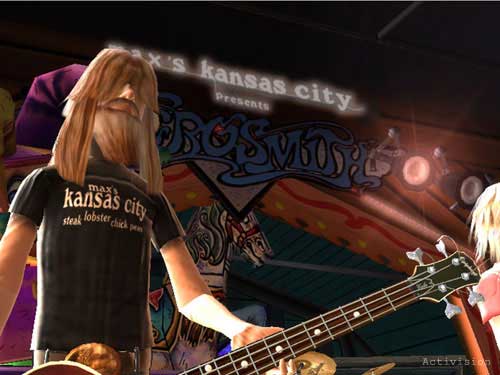
Honorable Mention: Guitar Hero Bassist
True, he may not be real, but the bassist from the first three Guitar Hero games has earned a place in the hearts of a generation of rockers. A master of almost every style, this bearded gent gently grooved in the background, providing the perfect backup to our young air guitar dreams. He never messed up, was there to support us if we failed with a mellow bob of the head and another go. When I learn the bass, I aspire to be like him.
 Then Play On
Read through this list and was hoping you’d have Paul McCartney ranked. Poor George wasn’t even the best bassist in the Beatles. And Flea OF COURSE. Dead on accurate ranking as far as the realm of rock.
LikeLike